Ambient AI documentation left the outpatient clinic behind in 2026. In May, Abridge made its nursing documentation product generally available across more than 250 US health systems. Inpatient nursing suites, emergency department deployments, and post-acute tools followed through the summer. A Spanish hospital network published a full year of emergency department results covering more than a million scribe-assisted consultations. The expansion forces a question that product demos rarely address: what happens to the medical record when a model writes the first draft of every encounter.
The bedside is a different product
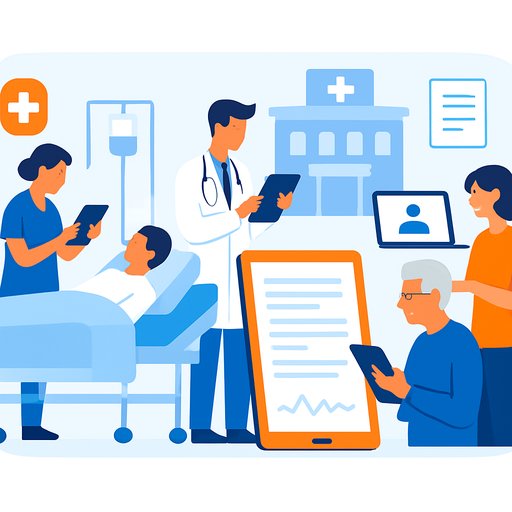
Physician ambient scaled quickly because a physician encounter ends in a note. A nursing shift ends in hundreds of discrete flowsheet fields. No amount of fluent prose fills them. Cassie Marcelle, vice president of clinical informatics and CNIO at UF Health, said the nursing version is a different system operating behind the same brand name because it must land in discrete fields. Marc Perkins-Carrillo, CNIO at Moffitt Cancer Center, cited an estimate that nurses spend roughly 40 percent of a shift documenting across 600 to 800 data points. Much of the reporting the rest of the enterprise depends on is drawn from that structured data.
Epic's approach routes dictated content into flowsheets. Entries appear in purple, marked unfinalized, and the nurse accepts or modifies each one. The system attaches the voice recording for that section, so a nurse who does not remember saying a patient had no bowel sounds can replay the moment. That review step earns its place because nurses move room to room and reconstruct each encounter from memory.
Hardware has landed on the critical path. Marcelle's nursing devices run Android while the vendors piloting nursing ambient are piloting on Apple hardware, with Android support arriving on vendor-specific timelines. A device decision made years ago now determines when a unit can go live. The harder problem is behavioral. Ambient capture requires nurses to narrate assessments aloud, a habit that disappeared from practice decades ago once graduates started clicking into a computer. Some nurses use the discrete fields as a checklist, so removing the clicks also removes the prompt that told them what came next.
What the evidence from high-acuity settings shows
The largest published emergency care evaluation came out of a Spanish hospital network in July. Across 48 hospitals and five emergency specialties, researchers tracked 12 months of use covering roughly 2.27 million emergency visits. The scribe was used in 1,032,558 consultations, or 45.3 percent of eligible cases. Monthly adoption climbed from 7.7 percent to 57.8 percent. Scribe-assisted consultations were shorter by a mean of 21.8 percent, and mean transcription accuracy held at 93.9 percent across the year. One caveat: the network developed the system in-house and employed all of the authors, two of them in management roles.
Those results are more favorable than the ambulatory record. Mass General Brigham observed a median reduction of 5.6 minutes of total EHR time per appointment. The Permanente Medical Group's far larger implementation found savings of 18 seconds per appointment compared with non-users. An Intermountain Health matched cohort study reported no statistically significant productivity gains. What holds up more consistently are softer outcomes: reduced cognitive load, lower burnout scores, and a Permanente finding that 84 percent of clinicians saw a positive effect on visit interactions.
Emergency departments, intensive care units, and operating theaters are noisy and interrupted by design. Alarms, code announcements, several simultaneous conversations, and nearby patients all degrade capture. Available products struggle to distinguish between speakers even in quiet rooms. Most record through a single device, usually a clinician's phone, which is a poor match for a resuscitation involving multiple physicians, allied staff, and family members. Patients in these settings generate several short contacts in a day rather than one scheduled visit, so a tool built around a single encounter must be re-engaged repeatedly.
The first mile of the medical record
A commentary published in Learning Health Systems in August makes the argument that goes missing in the productivity debate. Ambient scribes outsource what the authors call the first mile of clinical documentation, and clinical documentation is the substrate through which encounters become analyzable data. Notes feed population health dashboards, quality measures, risk stratification, clinical decision support, and institutional learning. When that translation is mediated by proprietary systems, the design choices inside those systems propagate outward.
Two examples show what propagation looks like in practice. Speech recognition error rates have been measured at roughly twice as high for Black speakers, which means documentation accuracy can degrade systematically for particular patient groups before any human reads the note. And when input data drifts, the models built on top of it fail quietly. The authors point to the Epic sepsis model's poor sensitivity and high false-alarm rate at Michigan Medicine, attributed to data drift and documentation variability. For professionals working in AI for Healthcare, these downstream effects are becoming central to implementation planning.
Note bloat compounds the problem. When capture outruns summarization, records grow long and redundant, shifting burden from writing to reading and degrading document quality over time. Nuanced patient history, social context, and pre-hospital detail are often filtered out by current tools. Those are precisely the details that matter when a patient moves from one care setting to another.
Governance that subtracts documentation
The practical lesson from the systems furthest along is that ambient performs better on top of documentation that has already been cut back. Cedars-Sinai reviewed its admission navigator around 18 months ago and removed 190 of 369 flowsheet rows. Lisa Stephenson, the CNIO there, said her informatics team joins the meetings where new documentation requirements get proposed so that every addition is questioned. Moffitt places an informaticist on every council and asks for the exact written specification whenever a requirement is attributed to an accreditor, on the reasoning that health systems add work to themselves and then blame the EHR for it.
Data governance is less settled. Ambient tools generate artifacts well beyond the finished note, including raw audio, conversation transcripts, draft outputs, user prompts, and provenance logs. The rules for retaining them are frequently unspecified. Health systems must decide what counts as transient processing data and what enters the legally binding record, or risk creating shadow records that conflict with the chart. Regulators have not resolved the classification question either. Pure transcription is unlikely to qualify as a medical device, while summarization and decision support can change what gets communicated and acted on.
Why this matters for healthcare professionals
Ambient documentation is arriving in inpatient units, emergency departments, and post-acute care, but the product that works there is structurally different from the ambulatory version. It requires nurses to change a decades-old documentation habit, and it generates structured data that feeds the quality measures, risk models, and decision support tools the enterprise relies on. Almost no published work has measured how AI-mediated documentation changes that data. For AI for Medical Records Clerks and clinical staff alike, the practical takeaway is that documentation-quality metrics, drift monitoring, and equity-focused evaluation belong in every rollout plan alongside the adoption dashboards. Very few organizations are running them yet.
Your membership also unlocks: