
AI news ·
AMD and France sign agreement to expand AI computing access and support Alice Recoque exascale supercomputer
AMD and France signed a letter of intent April 16 to build AI infrastructure, with AMD supplying hardware and training for Alice Recoque, France's planned exascale supercomputer. The deal aims to cut French dependence on foreign cloud providers.
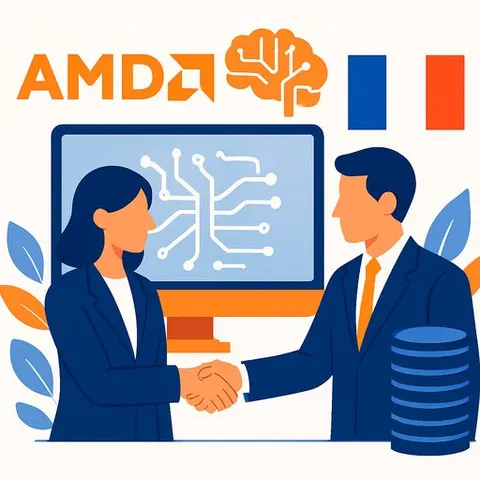
AMD and France Formalize AI Partnership to Build Sovereign Computing Capacity
AMD and the French government signed a letter of intent to deepen collaboration on artificial intelligence infrastructure, research, and workforce development. The agreement, signed April 16 at France's Ministry of the Economy, positions AMD to supply technology and expertise for Alice Recoque, France's planned first exascale supercomputer.
The multi-year partnership addresses a core government priority: reducing dependence on foreign AI infrastructure while building local expertise. French officials framed the deal as essential to the country's digital sovereignty strategy and its ability to compete in global AI development.
What AMD Will Provide
AMD will supply hardware, software, and training programs to French researchers, educators, developers, and startups. The company plans to establish a Center of Excellence connected to Alice Recoque to provide technical support and ecosystem guidance.
The hardware access flows through three existing AMD programs: the University Program, AI Developer Program, and AI Academy. These programs typically offer discounted or free access to computing resources for academic and startup participants.
Alice Recoque: The Infrastructure Anchor
Alice Recoque represents the centerpiece of France's AI infrastructure ambitions. The supercomputer will be operated by GENCI (the national supercomputing agency) and the CEA (France's atomic energy commission), giving government entities direct control over a critical computing resource.
France has positioned exascale computing-systems capable of performing a billion billion calculations per second-as essential to maintaining technological independence. Having domestic infrastructure reduces reliance on U.S. or Chinese cloud providers for sensitive research and industrial applications.
Government Objectives
French ministers emphasized three goals in their statements:
- Expanding AI research capacity by giving academics and startups access to advanced computing resources
- Strengthening the domestic AI supply chain, from semiconductors through software development
- Building a more resilient ecosystem by diversifying partnerships and supporting local startups
Philippe Baptiste, the minister overseeing higher education and research, said the partnership grants researchers "unprecedented access to cutting-edge infrastructures" while supporting France's position in global AI development.
Sébastien Martin, the industry minister, emphasized that AMD's commitment extends beyond hardware to include "local economic and social benefits," signaling government expectations that the partnership will create jobs and economic activity in France.
The Broader Context
This agreement reflects a wider European shift toward building independent AI capacity. France's National Strategy for AI, launched in 2018 and updated since, targets €1.5 billion in public investment through 2022 and positions AI as a strategic priority alongside semiconductors and quantum computing.
The partnership also signals AMD's strategy to expand beyond U.S. markets by embedding itself in government-backed infrastructure projects across Europe. Similar arrangements have emerged in other countries seeking to reduce dependency on U.S. cloud platforms.
Government officials will likely track this agreement as a model for how to structure public-private partnerships in AI infrastructure. The involvement of multiple ministries-higher education, industry, and digital affairs-suggests coordination across government silos, a common challenge in AI policy implementation.
For professionals in government technology and policy roles, this deal illustrates how infrastructure partnerships can serve dual purposes: advancing research capacity while building domestic capability in strategically important sectors. Learn more about AI for Government initiatives and AI Research Courses to understand these dynamics.