
AI news ·
Musk and OpenAI lawyers make closing arguments in trial over nonprofit origins
Closing arguments wrapped Thursday in Elon Musk's lawsuit against OpenAI, where he claims CEO Sam Altman broke a charitable trust by taking the company profit-driven. The verdict could block OpenAI's planned IPO.
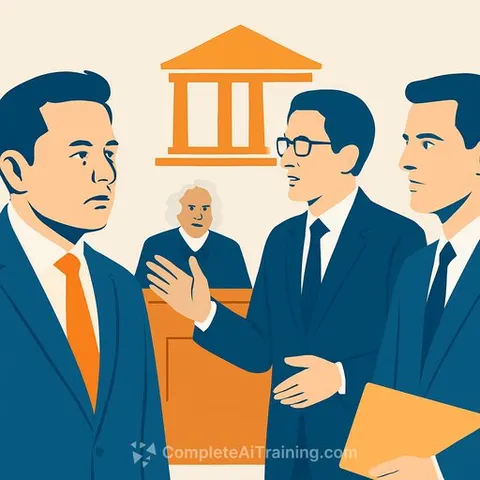
Musk and OpenAI Make Final Arguments in Trial Over AI Company's Direction
Lawyers for Elon Musk and OpenAI presented closing arguments Thursday in Oakland federal court in a lawsuit that could determine control of one of the world's most valuable AI companies and influence how the industry develops.
Musk, a co-founder of OpenAI, claims CEO Sam Altman and President Greg Brockman violated a charitable trust by converting the nonprofit into a profit-driven venture without his consent. The lawsuit, filed in 2024, seeks to remove Altman from leadership, restructure OpenAI's business, and secure billions in damages for the company's charitable arm.
The trial outcome matters beyond the courtroom. OpenAI, Musk's AI startup, and Anthropic-founded by seven former OpenAI employees-are all planning initial public offerings expected to rank among the largest ever. An Musk victory could derail OpenAI's IPO.
The Credibility Question
Musk's attorney Steven Molo centered his closing on Altman's trustworthiness. Five witnesses-including Musk, co-founder Ilya Sutskever, former CTO Mira Murati, and two ex-board members-testified under oath that Altman lied.
"Sam Altman's credibility is directly at issue in this case," Molo told jurors. "The defendants absolutely need you to believe Sam Altman. If you cannot trust him, if you don't believe him, they cannot win."
Because no written contract exists documenting a charitable trust, Musk's side argued jurors should consider emails, website language, and press interviews as evidence of an agreement.
OpenAI's Defense
OpenAI lawyer Sarah Eddy countered that Musk's own testimony contradicts every other witness. She said Musk knew of and supported plans to create a for-profit subsidiary that would still serve the company's mission.
Eddy noted that Musk had discussed his children inheriting control of OpenAI, suggesting his real goal was dominance over artificial general intelligence-advanced AI that surpasses humans across many tasks.
"Mr. Musk wanted total control," Eddy said. "Maybe he'd give it up over time, or maybe not. But it was up to him and that was the problem."
Timeline and Legal Hurdles
The jury faces multiple questions. First: did Musk file his lawsuit within the statute of limitations? OpenAI argues he waited too long and cannot claim harms before August 2021.
U.S. District Judge Yvonne Gonzalez Rogers indicated in a court filing that if jurors find the lawsuit missed the deadline, she will likely direct a verdict for the defendants.
If the timeline holds, jurors must then decide whether a charitable trust existed and whether Altman, Brockman, and OpenAI unjustly enriched themselves. They must also determine whether Microsoft-OpenAI's largest investor-aided and abetted any breach.
The Money Question
During a tense exchange, Judge Gonzalez Rogers criticized Musk's attorney for telling jurors that Musk sought no money. While Musk dropped his personal damage claim before trial, he is still seeking billions in disgorgement for OpenAI's charitable foundation.
The judge ordered the statement corrected to jurors.
Outside Pressure
More than a dozen protesters gathered outside the courthouse, opposing both parties as billionaires whose industry threatens workers, the environment, and humanity itself.
"The thing is, we're all losing," said Saru Jayaraman of a campaign pushing a $30 hourly wage. "Who's really winning? The two of them."
Musk was in China with President Donald Trump during Thursday's arguments. Altman and Brockman attended in person.
For professionals in government, science, and research, this trial carries weight. The court's decision will set precedent for how founders can claim rights over AI companies after departure and how nonprofits can transition to profit-driven models. Learn more about Generative AI and LLM Courses and AI for Legal Professionals to understand the technical and legal dimensions of these disputes.