
AI news ·
Americans share Pope Leo's fears about unregulated AI and its threat to workers, privacy and human life
Pope Leo this week called AI one of humanity's greatest threats, demanding strict ethical limits. Americans echo that alarm, citing worker displacement, surveillance, and an industry built to outrun regulation.
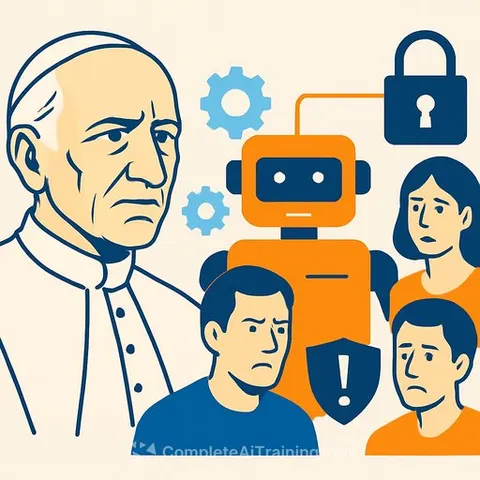
Americans voice alarm over unregulated AI, echoing pope's ethical warnings
Pope Leo issued a sweeping critique of artificial intelligence this week, calling it one of the greatest threats facing humanity and demanding the "most rigorous" ethical constraints on the technology. In his first major papal text since taking office, he warned of "new forms of slavery" emerging through the digital economy and denounced the "culture of power" driving AI development.
Americans across the country share his concerns. In conversations with the Guardian, U.S. readers described AI as an unregulated industry increasingly deployed to the detriment of workers, privacy, and democratic institutions.
Worker displacement and surveillance fears dominate concerns
Stephen Sincoskie, a 55-year-old print shop supervisor in New Jersey, said unregulated AI poses a threat to workers, privacy, and human life. He worries the technology will replace workers while enabling a surveillance state, and expressed skepticism that tech leaders would support policies to mitigate these harms.
Linda Given, a 74-year-old Boston resident who ran a gift store for nearly 40 years, said the pope was right to emphasize human dignity. She warned that using AI as a substitute for human interaction is "awful" and that the technology could easily be manipulated for destructive purposes.
Scott Gibb, a 70-year-old California retiree, called for moral leadership on the issue. "Someone needs to have some moral clarity around this issue and it sure isn't Sam Altman, Mark Zuckerberg, Jeff Bezos or Elon Musk. They are soulless," he said.
Education and critical thinking in decline
Debra, a 58-year-old college professor in Massachusetts, said AI is eroding students' ability to think critically. "AI is robbing many students of the need to think critically, learn the ways of research and express themselves by writing," she said.
Environmental costs and military applications
Lauren, a Baltimore-based reader who works in international aid and relief, praised the pope's intervention as necessary moral leadership. She pointed to AI's environmental toll and its expanding role in warfare.
"AI is consuming natural resources and land at an alarming pace, for dubious benefits," she said. "It is already used in war, and there are concerns it has accelerated conflicts and led to the killing of civilians."
Tech industry strategy outpaces regulation
Sam Bakkila, a 37-year-old computer science instructor in New York City, said AI is being developed by technology leaders pursuing a deliberate strategy to outrun government oversight. "Their whole strategy is to move fast, break things, and take advantage of government bureaucracy's inability to regulate them in a timely manner to create hugely powerful monopolies before the government can catch up," he said.
Bakkila argued that understanding current American politics requires examining AI's role. Tech CEOs, he said, supported specific political outcomes because they recognized that a four-year period would be crucial for AI adoption without regulatory constraints.
AI compared to nuclear weapons
Paul, a 67-year-old former ethics and logic professor in Wisconsin, compared AI to nuclear weapons-both capable of mass harm across the globe. He noted that humanity has successfully applied shared ethical rules to prevent nuclear use since 1945, yet AI development proceeds without comparable ethical guardrails.
"AI has equal power to create conditions to harm, even kill millions of humans," Paul said. "Yet, there isn't a whit of ethical programming built in, except to serve a global oligarchy in domination of everything."
Skeptics question the pope's authority
Not all readers agreed the pope's perspective carries weight in the AI debate. Charlie Hinkle, a 60-year-old tech worker in Charlotte, North Carolina, questioned why religious authority should influence policy discussions in an increasingly secular world.
A 76-year-old firefighter in Oklahoma dismissed the framing of religion versus AI as a false choice, arguing both represent external systems that enable manipulation.
For government officials tasked with developing AI policy, these concerns reflect broader public anxiety about the pace and direction of AI development. AI for Government resources can help policymakers understand both the risks and the mechanisms for effective oversight. AI for Executives & Strategy training addresses how leaders can implement ethical constraints and governance structures that balance innovation with public protection.