Workers Are Using AI They Don't Trust, and HR Faces a Governance Crisis
American workplaces are adopting artificial intelligence at accelerating speed - even as trust in the technology collapses. A Quinnipiac University poll released this week reveals a workforce adapting to AI while doubting both the tool itself and the executives deploying it.
The numbers expose a stark contradiction that should concern every chief human resources officer. Fifty-one percent of Americans now use AI to research topics. Nearly one-third of employed adults use it on the job. Yet 55 percent believe AI will do more harm than good, 70 percent think it will reduce job opportunities, and 76 percent trust AI-generated information only sometimes or hardly ever.
This is not a workforce in revolt. It is a workforce making pragmatic choices in an environment of deep uncertainty - and that distinction matters enormously for how HR leaders should respond.
The Trust-Usage Gap Is the Real Problem
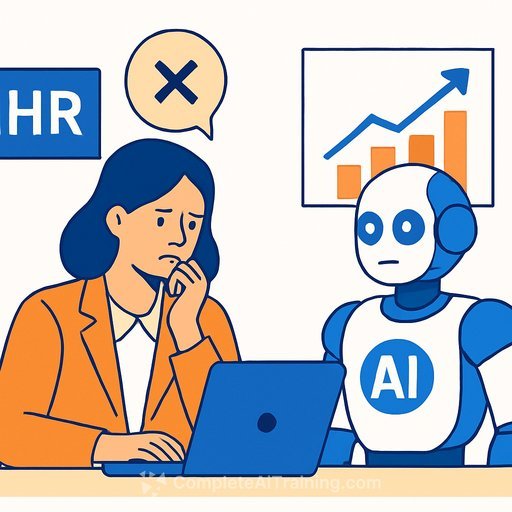
The most strategically significant finding may be the quietest one buried in the data: a substantial portion of the American workforce is regularly using AI tools to inform business decisions while explicitly distrusting those tools.
More than a quarter of employed adults use AI to analyze data. Three-quarters of those same adults said they can trust AI-generated information only some of the time or hardly ever. The arithmetic is uncomfortable.
This is not an adoption problem that marketing or change management can fix. It is a judgment and governance problem. Workers need the critical literacy to know when to trust AI output and when to override it - and the organizational structures to do so safely.
Gen Z Is More Pessimistic Than Any Other Generation
A common boardroom assumption is crumbling: that younger workers, raised on technology, will naturally embrace AI transformation.
Eighty-one percent of Gen Z respondents said they believe AI will reduce job opportunities. That compares with 66 percent among baby boomers and 57 percent among the silent generation. Gen Z's familiarity with AI appears to have produced not enthusiasm but clear-eyed anxiety.
The reason is straightforward: entry-level and early-career roles - the jobs Gen Z currently occupies - are among those most exposed to AI's disruptive potential. Younger workers recognize this directly.
Companies that have built their AI narratives around generational enthusiasm may find those narratives do not hold. The implications for recruitment and retention are considerable.
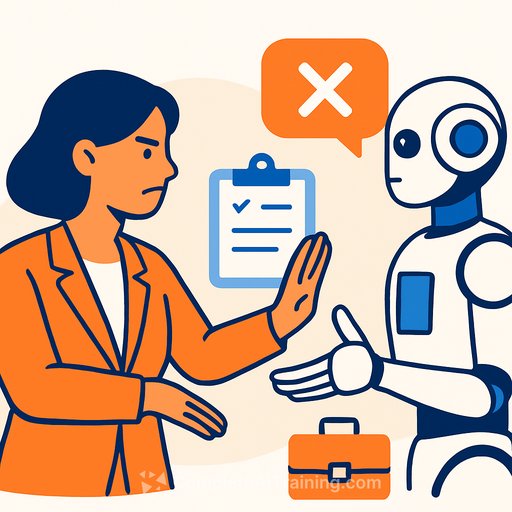
Workers Will Use AI Tools. They Won't Accept AI Bosses.
The survey draws a clean line between what workers will accept and what they will not.
Eighty percent of Americans said they would be unwilling to work for an AI supervisor that assigned tasks and set schedules. The figure held consistent across generations, income levels, and job types. Even among Gen Z - the most fluent with AI tools - 82 percent said they would be unwilling.
When asked whether they would prefer AI alone, a human alone, or both to read medical scans (even if AI were proven more accurate), 81 percent chose the combination. Only 3 percent said they would rely on AI alone.
Workers appear willing to use artificial intelligence as an instrument. They are not willing to be governed by it. For HR departments overseeing rapid expansion of AI-assisted tools in performance management, scheduling, and productivity monitoring, that distinction represents a hard constraint unlikely to soften.
White-Collar and Blue-Collar Workers Share the Same Anxiety
Another assumption the data undermines: that AI anxiety concentrates among lower-skilled workers while professional employees are broadly comfortable with the technology.
Seventy-three percent of blue-collar workers believe AI will reduce job opportunities. Among white-collar workers, the figure is 71 percent - a difference within the survey's margin of error.
What does differ significantly is current usage. Nearly half of white-collar workers report using AI on the job, compared with 18 percent of blue-collar workers. Professional employees are not more sanguine about the technology. They are simply further along in confronting its implications in practice.
For HR, this means a reassurance message calibrated to frontline workers while assuming the professional workforce is on board will miss a significant portion of the talent most critical to organizational success.
Three-Quarters of Workers Say Companies Aren't Being Transparent
Seventy-six percent of Americans said businesses are not doing enough to be transparent about how they use AI. Seventy-four percent said the government is not doing enough to regulate it. Forty-seven percent do not believe AI development is being led by people or organizations that represent their interests.
This is a trust environment that is deteriorating, not stabilizing. Every corporate AI communication is being received against this backdrop of institutional skepticism.
Vague assurances about responsible deployment carry little weight. The organizations that will meaningfully shift worker perception are those that can answer concretely: Which tools are in use? What decisions do they inform? What human oversight exists? What recourse do employees have?
Specificity and credibility are no longer optional. They are the baseline for organizational credibility on AI.
What HR Leaders Need to Do Now
The financial stakes around AI are enormous. Amazon, Meta, Google, and Microsoft plan to spend a combined $650 billion on AI infrastructure this year. Boards are pressing for evidence that productivity returns are materializing.
The Quinnipiac data suggests those returns will not come from technology alone. They will come from workers - and from the organizations that have built the trust, capability, and cultural conditions that turn anxious, low-confidence adoption into genuine productivity.
That work belongs primarily to the chief human resources officer. The immediate priorities are clear: build worker literacy in AI judgment and governance, establish human oversight in all people-related AI decisions, and communicate with specificity about how AI is being used in hiring, performance evaluation, and workforce planning.
The gap between accelerating adoption and deepening unease is not closing on its own. It closes when HR leaders treat it not as a communication problem but as a governance and capability problem - one that requires concrete action, not reassurance.
For HR professionals navigating these challenges, AI for CHROs (Chief Human Resources Officers) provides frameworks for managing AI adoption while building organizational trust. Additional resources on AI for Human Resources cover recruitment automation, talent management, and workforce analytics in detail.
Your membership also unlocks: