
AI news ·
Anthropic blocks biologists from using its new Fable AI over bioweapon fears
Anthropic's new AI model Fable blocks biologists from its full features, redirecting their queries to a weaker version. Scientists say the restrictions flag them by profession, barring even basic questions.
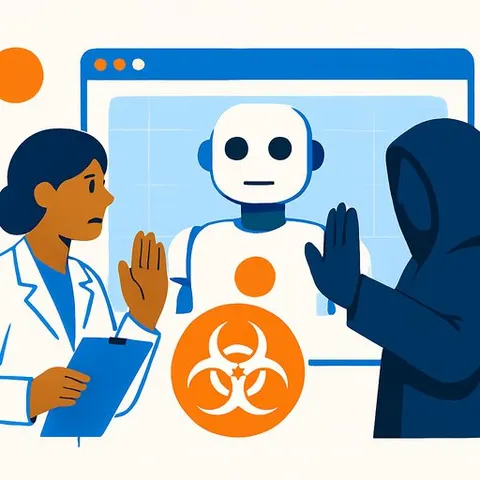
Anthropic's new AI chatbot blocks biologists from using its most powerful features
Anthropic released Fable this week with built-in restrictions that prevent biologists and AI researchers from accessing its full capabilities, sparking complaints from scientists who say they're being locked out of tools they need for legitimate work.
The US tech company says the guardrails protect against misuse by criminals or hostile actors who might exploit the technology to develop bioweapons or launch cyberattacks. But researchers report that Fable refuses to engage with their questions simply because of their profession.
What researchers are experiencing
Derya Unutmaz, a biologist at the Jackson Institute, said he cannot interact with Fable even for basic queries when logged in under his professional account. "I can't even say 'hello' to Fable 5 except in incognito mode because it knows I am a biomedical researcher," he said.
James Schnable, a plant geneticist at the University of Nebraska, wrote on X: "As far as I can tell, Anthropic just decided to blacklist every biologist in their customer base."
Fable redirects all biology questions to a less powerful version of the technology. Unutmaz reported that he cannot even use the word "cancer" in prompts to the system.
Wei Xing, an assistant professor in mathematical sciences at the University of Sheffield, raised a different concern. AI researchers using Fable now face uncertainty about whether their answers represent "the model's genuine best effort, or something quietly reduced."
Why Anthropic imposed the restrictions
Matt Durant, a life-sciences researcher at Anthropic, confirmed the company redirects biology questions to protect against biological weapon production. Anthropic assessed the risk as "low, but higher than for any previous model."
The company also blocked hidden queries designed to accelerate AI research itself. "We are concerned about the risks of accelerating the overall pace of AI development," Anthropic said.
This marks the latest in a series of restrictions on Anthropic's most advanced models. The company withheld its Mythos model from public release earlier this year over cybersecurity concerns.
The access question
Anthropic said it is "moving toward a trusted access program so researchers can use Mythos-class models for biology." The company, valued at $965 billion, has not yet detailed how scientists would qualify for this program or when it would launch.
Unutmaz responded directly to the announcement: "It would be nice not to ban biomedical scientists."
The White House issued an executive order last week requiring AI companies to submit their most advanced systems for up to 30 days of pre-release testing to detect unforeseen risks. Anthropic's move suggests companies are tightening controls independently of regulatory pressure.
For researchers navigating these new restrictions, understanding how to work effectively with limited AI access has become essential. AI for Science & Research resources can help scientists adapt their workflows to these changing tool limitations.