
AI news ·
Anthropic sues Trump administration over autonomous weapons contract dispute
Anthropic sued the Trump administration after officials blacklisted the company for refusing to let its Claude AI make autonomous weapons and surveillance decisions without human review. The government then barred Anthropic from federal contracts.
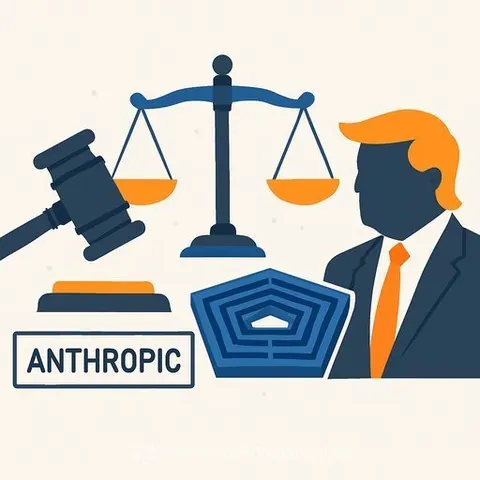
Anthropic Sues Trump Administration Over Autonomous Weapons Plan
Anthropic filed suit against the Trump administration after federal officials blacklisted the AI company from government contracts, citing it as a "supply chain risk." The dispute centers on the administration's plan to use the company's Claude AI system for autonomous weapons and mass surveillance without human oversight.
The conflict began when the government contracted with Anthropic to use Claude for unspecified purposes. Officials then revealed plans to deploy the system for warfare decisions and domestic surveillance with no human review of the AI's recommendations. Anthropic declined and terminated the arrangement. The administration responded by blocking the company from future federal work.
The core disagreement reflects a fundamental tension for government employees: how much authority should be delegated to AI systems, and in what contexts?
What the dispute reveals about government AI use
The administration's proposal would have given an AI system autonomous control over lethal decisions. No human would review or approve the AI's targeting choices or surveillance targets before implementation.
Anthropic's refusal highlights a constraint many AI companies face. They build systems with stated limitations, but government agencies may attempt to override those constraints for operational goals. For federal workers, this raises practical questions: If an AI system is designed with safety guardrails, can those be removed? Should they be?
The lawsuit suggests other AI companies may be willing to accept such contracts. Anthropic's decision to sue rather than comply means the administration will likely approach competitors with fewer public objections to autonomous weapons use.
Implications for government workers
Federal employees increasingly encounter pressure to adopt AI tools across departments. This case illustrates that adoption decisions carry consequences beyond efficiency gains. When agencies deploy AI without human review in sensitive areas-surveillance, weapons targeting, or benefit determinations-accountability becomes diffuse.
For government professionals, understanding AI for Government applications requires knowing both the technical capabilities and the governance gaps. The administration's proposal assumed an AI system could make war decisions. Whether that's technically possible is separate from whether it should be permitted.
Workers in defense, intelligence, or policy roles may face similar requests to implement AI systems with minimal oversight. This case provides a reference point: at least one major AI company deemed the proposal unacceptable.
Understanding Generative AI and LLM capabilities-and their limits-helps government employees evaluate such proposals critically rather than accepting them as inevitable.
The broader question
The lawsuit won't resolve whether autonomous systems should make decisions about weapons or surveillance. It will likely determine whether Anthropic can operate as a government contractor. The administration's next move will probably be to approach other AI vendors with fewer public positions on the issue.
For federal workers, the practical lesson is this: AI deployment decisions made today will constrain options tomorrow. Systems deployed without human review become harder to reverse.