
AI news ·
Apple executive departs for OpenAI as memory costs and supply chain risks mount
Apple VP Paul Meade is leaving for OpenAI. The news comes as Apple's chip lobbying erased $263B in market value.
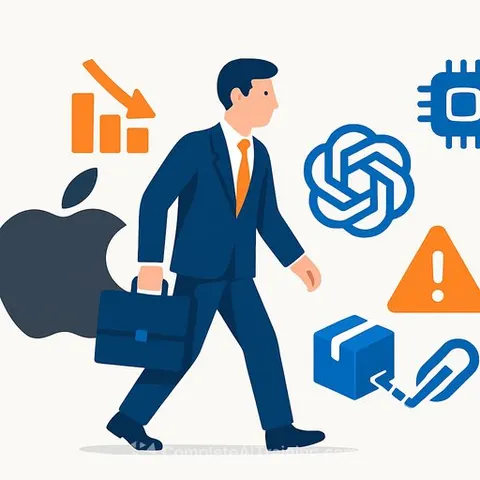
Paul Meade, Apple's vice president responsible for the Vision Pro headset and AI-powered smart glasses, is leaving the company to join OpenAI's hardware division, according to Bloomberg. The exit comes as Apple simultaneously lobbies the Trump administration to source memory chips from Chinese manufacturer CXMT amid soaring DRAM costs, a move that erased $263 billion in market value in a single session.
Leadership exits and internal restructuring
Meade's departure follows a broader reshuffling inside Apple's hardware engineering organization. John Ternus, widely expected to succeed Tim Cook as CEO, has been realigning leadership roles, leaving several senior hardware executives with diminished responsibilities. This internal shift has opened a door for OpenAI to recruit experienced talent, with Meade's move signaling the company's deepening focus on consumer hardware.
These simultaneous pressures-talent flight and supply chain cost-underline the need for a strategic approach that encompasses AI for Executives & Strategy.
OpenAI's hardware ambitions accelerate
OpenAI is already collaborating with former Apple design chief Jony Ive on an AI-native device that CEO Sam Altman has described as a calmer, less distracting alternative to smartphones. While reports last year indicated design and engineering hurdles, Meade's experience in consumer hardware could speed up those efforts. His background includes leading development of Apple's AI-powered smart glasses, a product expected to launch next year as the company pivots toward lighter, more affordable wearables after the Vision Pro's commercial underperformance.
Memory chip costs and geopolitical risk
Apple is also confronting rising memory costs. The company is lobbying for approval to buy DRAM chips from CXMT, a Chinese manufacturer, as conventional memory prices soar, the Financial Times reported. Apple recently raised prices on MacBooks and iPads, citing "unsustainable" memory costs, and the announcement triggered the $263 billion market-cap drop. Unlike advanced AI chips, Apple is not barred from purchasing memory from CXMT, but the company appears on the Pentagon's Chinese Military Company blacklist, alongside YMTC, over alleged military links. While inclusion does not ban trade, any procurement relationship would face political scrutiny.
The global DRAM market has shifted significantly. After an oversupply drove prices down in 2023, the rapid build-out of AI infrastructure redirected manufacturing capacity toward high-bandwidth memory (HBM) for AI accelerators. That has created a shortage of conventional DRAM used in laptops, smartphones, and tablets, pushing costs higher for manufacturers like Apple. Today, the market is dominated by Micron, Samsung, and SK Hynix. Adding CXMT would diversify supply but expose Apple to heightened geopolitical risk. The memory chip shortage and the search for alternative suppliers highlight the operational challenges that AI for Operations must address.
Why this matters for executives and strategy
Apple's experience shows that succeeding in the AI era requires more than breakthrough products. Talent retention, supply chain resilience, and geopolitical risk management are now strategic imperatives. For executives, the lesson is clear: AI strategy must be treated as an integrated discipline that spans product development, talent investment, and supplier diversification. The companies that will lead are those that manage these dimensions as a unified whole, not separate silos.