
AI news ·
Arizona governor vetoes AI education bill over charter school and curriculum concerns
Gov. Katie Hobbs vetoed HB 4005 on June 19, rejecting AI literacy rules for five grade levels. Supporters want lawmakers to revise the bill to include charter schools.
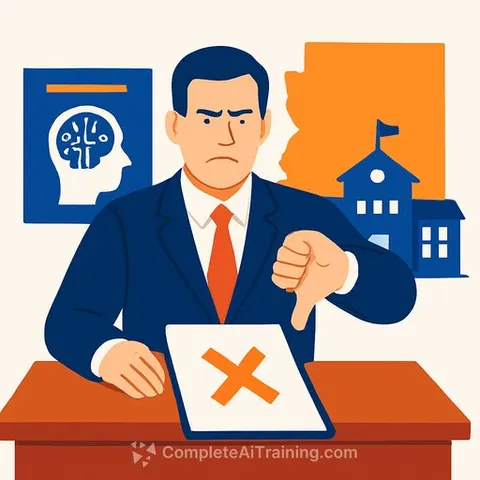
Arizona lawmakers should revisit a vetoed bill that would have embedded AI literacy into public school curricula, supporters say, after Gov. Katie Hobbs rejected the legislation on June 19. House Bill 4005 passed the Legislature with the goal of requiring instruction on the ethical, moral, and educational uses of artificial intelligence for students in grades three, six, eight, ten, and twelve. The veto left Arizona without a statewide framework for teaching students how to use AI tools responsibly at a time when such skills are essential in workplaces.
What the bill would have done
The proposal sought to embed AI literacy at key grade levels, going beyond technical how-tos. Curriculum would cover how to identify fabricated or misleading AI outputs, detect bias in systems, and weigh the ethical consequences of relying on AI-driven decisions. The goal was to build critical thinking skills students need to evaluate AI-generated information in academic and civic settings.
Why the governor said no
In her veto message, Hobbs said charter schools should be held to the same academic standards as district schools. The version of HB4005 that reached her desk excluded charter schools after earlier amendments removed them. She also argued that curriculum design should be led by education experts, not politicians, a point that supporters say was already partially addressed in the bill's structure.
The push for a second chance
Proponents of AI education argue that the governor's concerns can be fixed without abandoning the bill's core mission. Restoring charter school inclusion would create a consistent requirement for all publicly funded students. To address the curriculum-design objection, they suggest authorizing a broader collaboration among Arizona universities - involving experts in computer science, education, ethics, and social impact - rather than pointing to a single institution. Arizona State University's School for the Future of Innovation in Society is one example of the kind of partner that could help shape the material.
Integrating AI instruction also places new demands on educators. The AI Learning Path for Teachers provides a framework for instructors building these skills, a resource that aligns with any future state requirement.
Beyond civic readiness, supporters point to an economic imperative. Arizona employers increasingly expect workers to understand and apply AI tools productively. Students who graduate without AI literacy risk losing ground to peers in states that adopt more forward-looking standards.
Why this matters for education professionals
For teachers and school administrators, a revived bill would codify AI instruction as a core academic expectation, not an elective enrichment. It would require curriculum alignment across grade levels and create demand for professional development that helps instructors teach these concepts effectively. Even without new legislation, districts that move early to build AI literacy programs will position their students ahead of the curve. The resources educators choose now - from structured learning paths to classroom-ready materials - will shape how Arizona's next generation handles increasingly powerful AI tools.