Arizona Lawmakers Pass Bill Restricting AI Use in Health Insurance Claim Denials
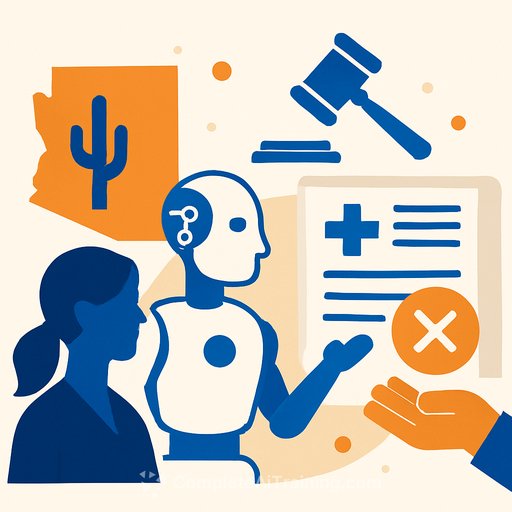
Arizona has taken a significant step to protect patients and healthcare providers from automated claim denials by health insurers. The state legislature approved a bill that restricts insurers from relying solely on artificial intelligence (AI) to deny health insurance claims. Instead, the measure mandates that a medical director must personally review every denial before it is finalized.
The bill received near-unanimous support in both the Arizona House and Senate and has backing from the Arizona Medical Association. This move addresses growing concerns over the increasing use of AI in insurance claim decisions and its impact on providers and patients.
Insurance Claim Denials and AI: Insights from Dr. Michael Dunn
Dr. Michael Dunn, a family physician and board member of the Arizona Medical Association, shared his experiences with AI-driven claim denials. He noted that although insurance companies often deny using AI in decision-making, legal cases have revealed otherwise.
According to Dr. Dunn, his practice has seen a noticeable rise in denials and downcoding that appear to come from AI systems. These denials often lack clear explanations and seem incorrect, unlike past denials which, even if disputed, showed evidence of human judgment.
“The denials don’t make sense and are frequently wrong,” Dr. Dunn said. He explained that while billing processes have inherent subjectivity, the current denials often include vague or nonsensical reasons. This suggests AI might be the culprit behind many questionable denials.
Growing Impact on Medical Practices
Dr. Dunn highlighted that the frequency of disputed denials has increased, affecting both small and large medical practices. While his urgent care practice experiences smaller reimbursement losses, surgical specialties face denials that can total thousands of dollars.
This trend threatens the financial viability of medical practices. Insurance reimbursements have stagnated or even decreased over the past two decades, despite rising overhead and staff costs. For many providers, even a few denied claims can push them into financial loss.
How AI Use in Claims Affects Patient Care
The pressure from denied or reduced reimbursements influences how doctors approach patient care. Dr. Dunn pointed out that expensive new technologies, like PCR testing performed in-office, face higher denial rates as insurers try to control costs. This creates hesitation among providers to adopt innovative but costly diagnostic tools.
As a result, medical decisions are increasingly influenced by insurance reimbursement policies, which may limit access to advanced care options for patients.
Balancing AI and Human Judgment in Insurance Decisions
Dr. Dunn supports the use of AI as a tool for initial claim screening but insists that human expertise must be involved in final decisions. The new bill, HB 2175, reflects this balance by allowing insurers to use AI for preliminary assessments while requiring a qualified medical professional to review and approve any denials or prior authorization refusals.
“AI can be useful, but it shouldn’t be the final authority,” Dr. Dunn explained. He emphasized that holding insurers accountable through human oversight is necessary to ensure fair and accurate claim handling.
This approach aims to reduce inappropriate denials while still benefiting from AI’s efficiency in processing claims. It also encourages transparency and better communication between insurers and healthcare providers.
Practical Takeaways for Insurance Professionals
- AI is increasingly used by insurers to manage claims but can produce questionable denials without human review.
- Legislation like Arizona’s HB 2175 sets a precedent for requiring medical director oversight on AI-driven denials.
- Insurance professionals should be aware of the regulatory environment evolving around AI and its impact on claim approvals.
- Balancing AI efficiency with expert human judgment benefits both insurers and healthcare providers by improving accuracy and fairness.
For insurance professionals interested in how AI can be integrated responsibly into workflows, exploring targeted AI training can be valuable. Resources such as Complete AI Training on automation offer practical courses that cover AI applications in insurance and claims processing.
Your membership also unlocks: