
AI news ·
Army Reserve soldiers develop artificial intelligence prototypes for Operational Sentinel Justice 26
Four Army Reserve Soldiers built three AI prototypes in a five-day sprint to automate tasks. They demonstrated the tools at a 12,000-person training exercise.
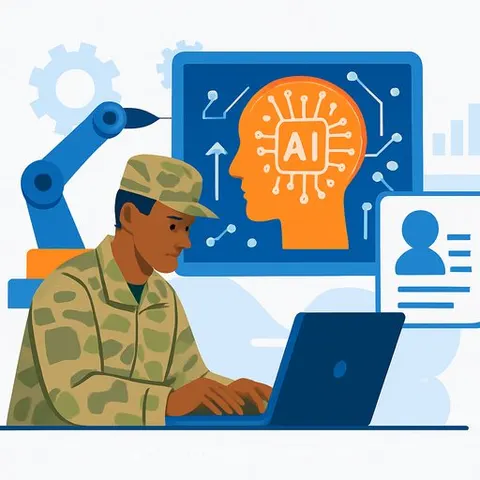
Army Reserve Soldiers from the 75th U.S. Army Reserve Innovation Command developed and tested artificial intelligence prototypes during a two-week code-a-thon in Austin, Texas, in May 2026, then demonstrated the tools at Operational Sentinel Justice 26, the largest training event in the Reserve's history. The effort showed how AI can modernize military operations by automating administrative tasks and improving readiness.
The code-a-thon, held May 3-16, was the fourth hosted by the Army Reserve Applications Group (AAG). Lt. Col. Jason Kim, deputy commander and AI product director, led the event. "As AI continues to disrupt commercial industries at a breakneck pace, it is vital that our current and future Soldiers learn to leverage these exact same capabilities to solve tactical and operational Army problems," Kim said. He pointed out that adversaries are using the same low-barrier-to-entry commercial AI tools to exploit tactical and administrative gaps.
Two goals: retention and rapid delivery
Kim said the sprint aimed to retain technical talent by giving Soldiers meaningful problems to solve with AI, and to prove the Reserve can deliver value faster than traditional acquisition. "I wanted to prove that our force can generate real value for the Army and Army Reserve in a fraction of the usual time," Kim said. The eight months of planning that preceded the event focused on creating a modern engineering environment with direct access to commercial-grade AI models.
Tools that target operational friction
Soldiers built three prototypes: a Video Retrieval-Augmented Generation (RAG) engine for military police tactical operations, a computer vision application to automate TA-50 equipment inventory, and a "Soldier Passport" system to simplify administrative readiness. These tools address real workflow bottlenecks, showing how AI for Operations can reduce the burden of repetitive tasks. Maj. Eric Metzler, an innovation team lead, said the experience highlighted the Reserve's deep technical bench. "Leading a team of data scientists against some of the Army Reserve's toughest problems has been very rewarding," he said.
Demonstration at Operational Sentinel Justice 26
OSJ 26, held June 7-20 at Camp Shelby, Mississippi, drew more than 12,000 participants for a multi-echelon combat training exercise. On June 15, Kim presented the Video RAG prototype to senior leaders from the 200th MP Command and the 75th USARIC. "Presenting at Operational Sentinel Justice 26 was an incredible milestone because it completely validated our hypothesis," Kim said. "The future of Army Reserve exercises must feature technical Soldiers and operators co-building AI solutions together at the tactical edge." He added that the five-day development sprint by just four Soldiers was "a blueprint for what future collective training looks like."
Why this matters for operations professionals
The code-a-thon model demonstrates that small, focused teams can rapidly prototype AI solutions to streamline administrative and planning workflows-tasks that often consume significant time in operational environments. For operations leaders in any sector, the takeaway is that pairing domain experts with data scientists in short, high-stakes sprints can yield practical tools that free personnel to focus on core mission responsibilities. The Army Reserve's approach offers a template for bypassing lengthy procurement cycles and directly addressing friction points with AI.