
AI news ·
Arnout Ter Schure argues AI strengthens financial analysis but depends on human judgment to function effectively
Financial analysts are pairing AI's data-processing speed with human judgment to improve forecasting accuracy. AI handles backtesting and pattern recognition; analysts define the questions and interpret results.
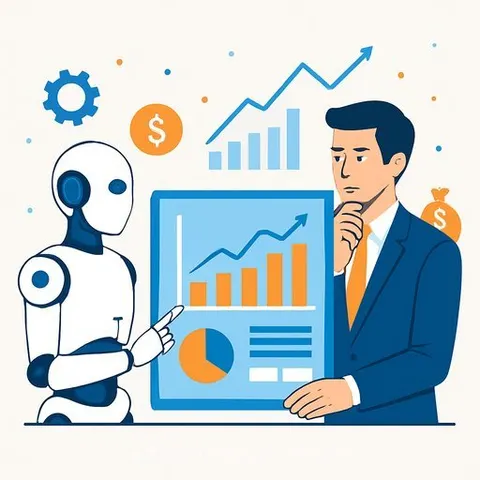
How Financial Analysts Are Using AI as a Computational Partner
AI can process massive datasets and identify patterns faster than humans ever could. But in financial forecasting, speed alone doesn't produce reliable predictions. The real value emerges when analysts combine computational tools with human judgment to interpret what the data actually means.
This is the working philosophy at Intelligent Investing, a research platform built on the premise that AI expands financial forecasting by accelerating data processing and strategy development. The founder, Arnout Ter Schure, brings a PhD in environmental sciences and over a decade of scientific research experience to the work. His background in repeatable patterns and data analysis shaped how he views AI's role in modern markets.
"Financial markets are becoming more complex and fast-moving," Ter Schure said. "That shift has sparked growing interest in how AI can play a supportive role."
Where AI Performs Well
AI systems excel at clearly defined tasks. Give them structured parameters and a specific objective, and they execute with speed and precision that humans cannot match. In trading and investment analysis, this translates to generating algorithms, coding strategies, and running backtests across years of historical data in minutes.
Research on multi-agent deep learning approaches to financial data shows that modern AI systems are particularly strong at processing large-scale information and identifying patterns across multiple timeframes. Combined with structured methods like the Elliott Wave principle, these systems improve pattern recognition in high-speed trading environments.
"AI excels when the task is clearly defined," Ter Schure said. "If you provide the structure, the parameters, and the objective, it can execute with remarkable speed and precision."
The Human Layer That AI Needs
Here's the catch: AI systems operate within boundaries set by humans. The data they analyze, the assumptions embedded in their code, and the frameworks they use all originate from human decisions. Without human direction, the system lacks purpose.
"AI can accelerate the 'how,' but it still depends on a human to define the 'why,'" Ter Schure said. "That distinction applies across every layer of market analysis."
This matters most during financial forecasting. AI can identify recurring patterns in historical data, but its perspective is limited to what already happened. When markets face structural changes or unprecedented conditions, historical data offers limited guidance. At those moments, human interpretation becomes as important as computational power.
Ter Schure approaches forecasting through probabilities rather than fixed predictions. "Markets evolve through a combination of structure and behavior," he said. "A model can highlight patterns, but understanding how those patterns develop in real time still requires human judgment."
Bias Flows Both Ways
AI systems learn from existing data and user inputs. Their outputs often reflect the perspectives embedded in that information. If the initial assumptions contain bias, the results typically will too.
"If the initial premise includes a bias, the output often reflects it," Ter Schure said. "The responsibility remains with the analyst to question, refine, and interpret the result."
This is especially relevant in markets driven by collective sentiment. Emotions like optimism and caution influence price movements. While AI can identify historical expressions of these behaviors, interpreting their significance in a current context requires experience and perspective.
"Regardless of the computerization of trading, market behaviour has remained constant," Ter Schure said.
How Ter Schure Combines Tools and Analysis
His methodology merges structured human analysis with technological tools. He combines Fibonacci ratios with Elliott Wave analysis, focusing on wave structures, extensions, and corrective patterns to interpret market cycles and map potential price movements.
A key element involves building multiple scenarios into the framework. "Each structure presents more than one pathway," he said. "By preparing for those alternatives, you create a framework that evolves with the market as new information becomes available."
This multi-scenario approach supports adaptability as conditions shift. Forecasts are refined as new data emerges, rather than locked into a single prediction.
While AI can assist in identifying patterns within these frameworks, interpreting complex wave structures introduces nuances that go beyond automated analysis. Multi-layered corrections and extensions often depend on contextual judgment, where small variations shift the broader interpretation.
The Practical Division of Labor
AI serves as an extension of the analytical process, enhancing specific components while leaving interpretation to the analyst. Its speed and precision complement the depth of human judgment.
"Technology expands what we can do, but understanding determines how we apply it," Ter Schure said. "The combination is where meaningful progress takes place."
For finance professionals, this suggests a clear division of labor. Use AI to handle high-volume computational tasks, pattern matching across large datasets, and rapid backtesting. Use human expertise to define the questions being asked, validate assumptions, interpret results in context, and make judgment calls when conditions break from historical patterns.
The goal isn't replacing one with the other. It's building a process where each does what it does best.