
AI news ·
Artificial intelligence automates tasks and improves efficiency in business operations
Firms use AI across HR, manufacturing, and finance to automate tasks and analyze millions of transactions. The goal is to augment human workers, not replace them.
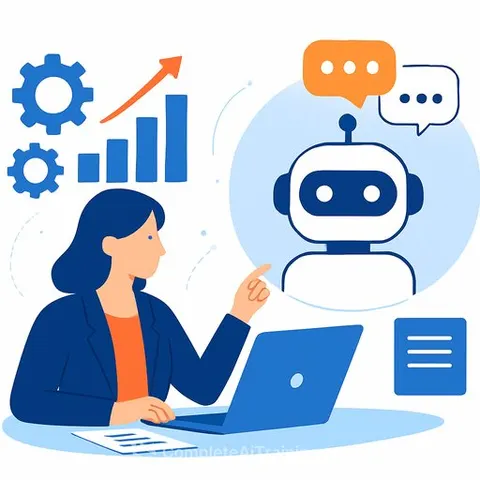
Artificial intelligence is no longer a future concept for business operations. Companies across sectors now integrate AI into daily workflows for hiring, manufacturing, customer service, and finance, seeking efficiency gains and better decision-making while supporting-not replacing-human workers.
Transforming hiring and human resources
HR departments have adopted AI tools to screen applications, identify qualified candidates, and sort resumes beyond simple keyword matching. David Magnani, President of M&A Executive Search, said that AI recruitment platforms save recruiters time by automating these early steps. Natural language processing enables more sophisticated screening, uncovering skills that might otherwise be missed.
AI chatbots handle common applicant questions, schedule interviews, and provide updates. Onboarding also benefits, with virtual assistants guiding new hires through documentation and offering personalized training suggestions. Predictive HR analytics help forecast turnover risk and employee engagement, suggesting retention strategies.
Companies must guard against algorithmic bias. The technology is meant to augment human judgment, not replace it. Transparent algorithms, diverse training data, and regular audits are necessary for fair hiring.
Customer service gets smarter
Customer service has seen one of the most visible AI transformations. Chatbots and AI-powered tools provide instant responses, reducing wait times. Advanced systems interpret the meaning behind queries, retrieve information, and solve routine problems. Complex issues are automatically routed to human agents when empathy or negotiation is needed.
AI also personalizes interactions by using purchase history, browsing habits, and past engagement. This data-driven personalization helps companies serve each customer more effectively.
Manufacturing and predictive maintenance
Manufacturing is another area where AI will be highly disruptive, said Jessica Shee of M3datarecovery.com. Modern factories rely on AI, machine learning, robotics, and the Industrial Internet of Things (IIoT). Predictive maintenance is a key application: sensors on machinery feed data to AI systems that detect wear and potential failures before they happen. This condition-based approach reduces downtime and maintenance costs.
Computer vision technology inspects products on the line at high speed, using high-definition cameras and AI algorithms to spot defects and improve quality. Production planning also gets smarter as AI algorithms consider demand history, inventory levels, and supplier performance to optimize schedules. Collaborative robots-cobots-work alongside human employees, handling monotonous or dangerous tasks and making workplaces safer.
Financial operations and fraud detection
Finance teams use AI to automate invoice processing, expense management, financial reporting, and regulatory filings. Fraud detection tools analyze millions of transactions, identifying abnormal patterns and learning from new data to catch emerging threats with fewer false positives.
Business leaders also tap AI for decision-making. Predictive analytics combine financial data with operational metrics to generate forecasts, flag risks, and evaluate strategic options based on data rather than intuition.
Responsible AI adoption challenges
Adopting AI comes with challenges around data privacy, cybersecurity, algorithmic bias, regulatory compliance, and workforce adjustment. Successful implementation requires high-quality data, clear policies, and employee training programs. Companies that provide education on AI technology enable their employees to learn how to work alongside such intelligent technologies and acquire new digital competencies.
Transparency in AI decision-making is essential to build trust. Organizations need to disclose how AI-powered technologies make decisions in areas like recruiting, lending, healthcare, and performance reviews.
Why this matters for operations professionals
For operations leaders, AI is already reshaping core processes. The technology can reduce waste, prevent equipment failures, and automate routine tasks, but only when integrated with strong governance and human oversight. Professionals who understand how to deploy AI responsibly, train teams, and audit algorithms will be best positioned to drive productivity gains while managing risk. The shift is less about replacing jobs and more about redesigning them around human-machine collaboration.