
AI news ·
Artificial intelligence drives initial healthcare layoffs in administrative roles while clinical jobs remain secure
Kaiser Permanente and Revere Health cut admin roles as AI hits U.S. healthcare. Cuts target coding and billing, but experts predict clinical layoffs and boomerang rehiring.
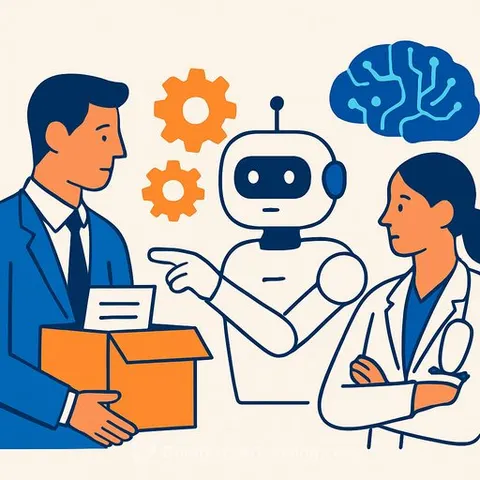
Kaiser Permanente and Revere Health have cut administrative roles as the first wave of AI-driven workforce adjustments hits the U.S. healthcare system. The restructuring, which mirrors recent mass layoffs in the technology sector, targets jobs in medical coding, billing, patient scheduling, documentation, claims denial prevention, and low-level tech support. No clinical positions have been eliminated or are slated for permanent replacement in the near future.
Non-essential roles face the axe first
The layoffs confirm a pattern that pulmonary and critical care physician Felix Reyes believes will hold: "My prediction is that the only jobs AI will replace are the jobs that were non-essential to the patient-physician relationship." Those roles, he said, grew out of changes in the business side of medicine and never constituted core medical work. The trend aligns with a surge in direct care practices that strip away administrative overhead to focus on the clinical encounter.
Oracle EHR and several health insurance companies have also trimmed their workforces in similar functions, signaling that the push to automate extends across the healthcare business ecosystem. However, Reyes cautioned that clinical providers will likely be caught in the hype cycle as well. "Rest assured that clinical providers will be fired during this AI hype cycle, later to be re-hired to reconstruct the workflows that AI helped 'transform,'" he said.
The boomerang effect after AI overreach
Research shows that most AI proof-of-concepts never reach production, stalling because of insufficient organizational readiness and fragmented IT infrastructure. The problem becomes exponential when data must be extracted from multiple systems that don't communicate with each other. After restructuring, a pattern called boomerang hiring - where former employees return to the same employer - has gained traction, a practice once seen as a disgrace now treated as routine business.
Reyes pointed to the cloud-computing and Internet-of-Things hype cycles that promised unified patient data but left healthcare "as fragmented as ever." The failure of those technologies to deliver on their promises serves as a warning for today's AI deployments, he suggested.
Medicine's messy reality resists simple algorithms
"Health care is messy and you can't skip steps," Reyes said. "Biologic systems are not as predictable as synthetic structures." Modern evidence-based medicine relies on statistical inferences drawn from an idealized average human. Building a large language model's predictive inference on top of that foundation amounts to "a supposition on top of a supposition, a proverbial house of cards," he explained. Multiple research studies have raised questions about the clinical validity of the data used to train such models.
As AI reshapes administrative workflows, healthcare professionals need to understand where the technology adds value and where it breaks down. Resources that offer a clear-eyed look at AI for Healthcare are becoming essential for sorting usable tools from overhyped promises. Reyes expects the near-term outcome to be increased work expectations for providers - a byproduct of institutional investments in unproven tools - followed by a round of provider layoffs intended to pressure those remaining into higher efficiency.
Why this matters for healthcare
The immediate risk for clinical professionals is not being replaced by AI, but being asked to do more under the weight of unvalidated technology. Layoffs will almost certainly hit some clinical roles during the current hype cycle, but the work will likely return as organizations discover that complex patient care cannot be automated away. The real danger is hubris: the belief that algorithms can short-circuit the messy, statistical nature of medicine. Staying informed about AI's actual capabilities and failures is the first line of defense against decisions that put patients at risk.