
AI news ·
Artificial intelligence reshapes corporate structures and hollows out middle management, report says
AI is hollowing out middle management by automating routine tasks, a Tsinghua report finds. Firms are flattening hierarchies so small specialist teams work directly with AI.
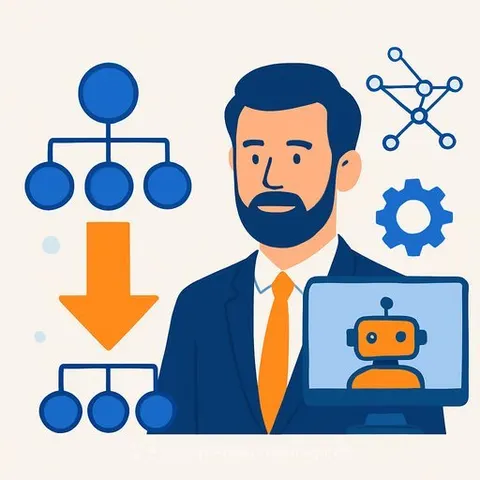
Artificial intelligence is hollowing out corporate middle management and pushing companies toward flatter, more flexible structures, according to a report launched at Tsinghua University on June 17. The study, a collaboration between recruitment platform Tongdao Liepin and Tsinghua's School of Economics and Management, warns that AI is no longer a back-office tool but an exponential force restructuring the global job market.
The Talent AI: Skills Trend Report in the AI Era was unveiled at a conference where industry leaders and academics discussed how AI is changing the nature of work. The report describes a shift toward human-machine collaboration that replaces traditional hierarchies with more flexible, project-based teams.
AI as an exponential force
"AI is no longer a simple technological add-on but an exponential force redefining business models and the nature of work itself," the report states. This means companies must rethink not just what work gets done but how they organize people to do it. The authors argue that AI's impact goes beyond automating routine tasks-it changes the fundamental economics of coordination and decision-making.
Middle management under pressure
AI's ability to process data and coordinate workflows is eating into the roles that middle managers have traditionally filled. The report finds that as algorithms take over scheduling, reporting, and performance monitoring, companies are removing layers of management. In their place, small teams of specialists work directly with AI systems, making decisions faster and with fewer intermediaries. These trends are consistent with the broader conversation around AI for Management, which examines how leadership roles are evolving.
Why this matters for managers
For managers, the message is clear: the skills that once guaranteed a career are becoming obsolete. The report suggests that to stay relevant, managers need to develop capabilities in data interpretation, AI system design, and leading cross-functional teams that include both people and machines. Strategic thinking and emotional intelligence become more valuable as routine coordination is automated. Senior executives can find deeper analysis of these strategic shifts in resources on AI for Executives & Strategy.