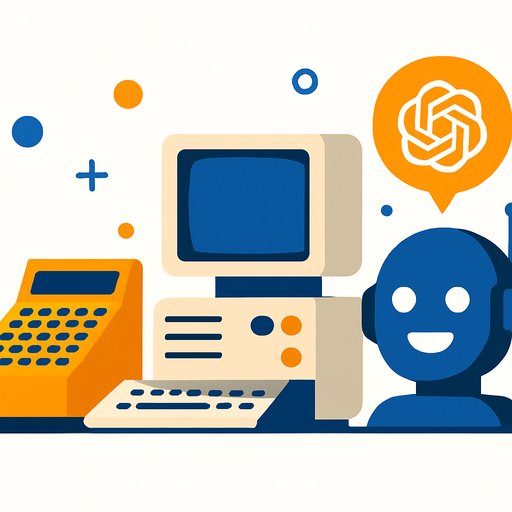
Artificial Intelligence: From Calculators to ChatGPT
Since the 1940s, the concept of artificial intelligence (AI) has shifted significantly. Its applications have grown in number and complexity, reflecting advances in both technology and theory. Understanding AI’s history helps clarify how its definition and scope have changed over time.
On an internet forum, a student asked whether the definition of AI has changed. Another user responded that they no longer consider AI a clear academic term. This confusion is common because the term "artificial intelligence" has never had a fixed meaning. Generally, AI is defined as machines performing tasks once thought to require human intelligence. But what exactly constitutes human intelligence? Experts from philosophy, cognitive science, and engineering do not agree, and the definition evolves as our knowledge advances.
Looking broadly, one might argue that AI’s roots extend back to the 19th century, when mechanical calculators first automated human arithmetic skills. However, AI as a distinct field is usually dated to the 1940s, coinciding with the rise of electronic computers.
The 1940s: Laying the Groundwork
The Colossus, one of the earliest electronic computers, was developed during World War II to decrypt German military messages. It outperformed previous electromechanical devices in speed and complexity. Subsequent computers became more programmable and capable of executing complex algorithms, enabling scientists to explore the idea of machines that could "think."
In 1943, Walter Pitts and Warren McCulloch introduced the concept of artificial neurons. Their model simplified how biological neurons function, laying an early foundation for neural networks, a core component of modern AI.
These initial developments set the stage for decades of research that would expand AI from a theoretical possibility to practical systems like ChatGPT.
- Key milestones in early AI:
- Development of programmable computers
- Introduction of artificial neuron models
- Exploration of algorithms simulating reasoning and learning
For those interested in exploring AI’s evolution in more depth or seeking education in this area, resources such as Complete AI Training offer up-to-date courses covering fundamental concepts through to advanced applications.
Your membership also unlocks: