Artificial Lawyer News Wrap: Legal AI You Can Use Today (14 November 2025)
Here's the signal, minus the noise. GPT-5.1 is landing well in legal, new tools are hitting production, and the deal sheet is busy. If you lead a legal team or run a practice, this is what matters and what to do next.
GPT-5.1: Better redlining, faster turnaround
Contract AI pioneer LegalOn tested GPT-5.1 against GPT-5.0 and GPT-4.1 using its Contract Review Benchmark (issue spotting, redlining, contract Q&A). The results:
- 67% win rate vs. GPT-5.0 on producing superior revisions
- 57% win rate vs. GPT-4.1 in direct redlining comparisons
- ~30% faster processing across contracting tasks
Translation for practice: cleaner first passes, shorter review cycles, fewer partner-level edits, and faster throughput for BAU contracts.
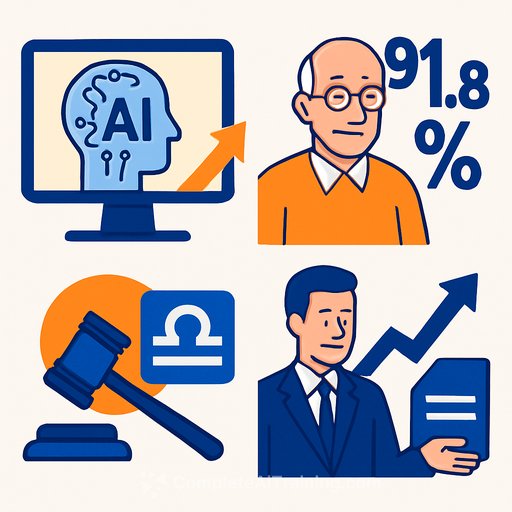
Harvey reports stronger instruction following and a 91.8% score on its BigLaw Bench-the highest for the GPT family on that suite. In short: closer adherence to playbooks and better consistency on complex prompts.
What to do now
- Run a 2-week bakeoff: your current model vs. GPT-5.1 on 50 real agreements. Track redline quality, time-to-first-draft, and partner rework.
- Codify your playbooks: turn "what good looks like" into prompt templates and guardrails. Measure adherence.
- Decide the routing: which matters go to associates first, and which go straight to AI-augmented review.
- Log exceptions: where the model falls short, capture patterns (clauses, jurisdictions, contract types) and adjust.
Events and learning
Legal Innovators New York runs Nov 19-20 in Midtown. Expect strong coverage from law firms, in-house teams, and vendors. Express Registration is available.
LexisNexis live webinar: "Creating an innovation culture: legal AI in practice" - Dec 2
- Speakers: Shilpa Bhandarkar, Nigel Lang, Isabel Parker, Gavin Shaw
- Chair: Richard Tromans
- Focus: how to encourage experimentation, reward adoption, and set norms without heavy-handed mandates
If your teams need structured upskilling, see practical AI pathways by role here: AI courses by job.
Legal education and access
Harvey has expanded its Law School Program to the UK: Oxford University Faculty of Law, The University of Law, The Dickson Poon School of Law at King's College London, and BPP University Law School. The program gives schools platform access plus faculty support for course integration.
Cambridge Judge Business School has launched the Frugal AI Hub to widen access to AI in emerging markets and low-income countries, including work on energy-efficient data centers. Learn more about the school here: Cambridge Judge Business School.
Deals, launches, and funding
- Wolters Kluwer Legal & Regulatory to acquire Berlin-based Libra Technology GmbH for up to €90m (€30m upfront; rest contingent). Libra's AI assistant supports research, drafting, review, and analytics for firms and in-house teams in Germany and beyond.
- Theo AI (litigation outcome prediction) funding:
- Nov '24: $2.2m
- May '25: ~$4.4m (including later SAFEs)
- Nov '25: $3.4m
- GitLaw raised $3m. It helps teams draft, review, and negotiate contracts using a library of 1,000+ lawyer-approved templates verified by experts in the US and UK-aimed at reducing generic outputs and grounding reviews in established standards.
- MAGIC Research launched an enterprise AI platform running on firm-controlled infrastructure (on-prem or private cloud). It ships with pre-built or custom agentic systems for discovery, drafting, research, contract review, and deposition prep, keeping client data and model execution inside the organization.
- Greenshoe raised $3m (seed) to automate and improve SEC disclosures.
- FromCounsel will launch new Restructuring & Insolvency Knowledge Content in Q1 2026.
- Litera connected Kira's contract analysis directly with Litera Transact, creating a single source of truth for deal progress and reducing workflow fragmentation.
- Callidus rebranded to StrongSuit, focusing on AI-powered litigation skills, including automated case validation ("shepardizing").
- Tradespace acquired Paragon (patent drafting) to cover the full IP lifecycle-disclosure through commercialization.
- Epiq sold its Global Business Transformation Solutions division to K2 Services.
Books and videos worth your time
- A Short Walk in AI by James Tuke (free e-book). Covers the economic "Great Unbundling," philosophical edges of AI, and practical ethics. Good primer for partners and legal ops.
- LawVu shows a clean approach to matter intake-useful if intake is your current bottleneck.
- Oz Benamram argues firms must share their knowledge with clients in the AI era-or risk losing them.
Practical next steps for legal leaders
- Stand up a GPT-5.1 pilot on your highest-volume contract type. Track cycle time, redline acceptance, and error rate.
- Refresh your AI usage policy: approved tools, data handling, privilege, confidentiality, and client consent.
- Set training by role: partners (risk and review), associates (prompting and playbooks), legal ops (metrics and workflow), IT/security (data controls).
- Demand vendor transparency: model versions, data flows, retention, indemnities, jurisdictional coverage, and audit logs.
- Secure your stack: prefer private deployments or strong isolation controls; verify logging and access rights.
- Report ROI quarterly: time saved, write-offs reduced, and quality metrics vs. prior baseline.
For broader legal AI literacy across your team, explore structured programs here: Latest AI courses. For vendor context, see: LexisNexis.
Bottom line: the bar just moved. Test fast, codify your standards, and put the right controls in place. The firms and legal departments that operationalize this now will set the pace for 2026.
Your membership also unlocks: