
AI news ·
ArXiv bans researchers for a year if they submit papers with unchecked AI output
ArXiv will ban researchers for one year if they submit papers with obvious unchecked AI errors, such as hallucinated references or leftover LLM prompts. After the ban, authors must clear peer review before posting again.
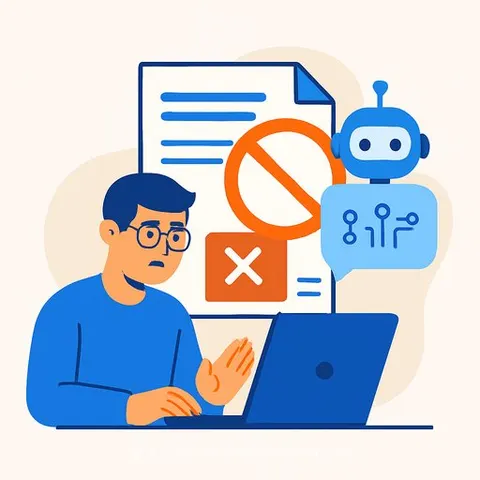
ArXiv Will Ban Researchers for Submitting AI-Generated Slop
ArXiv, the preprint repository used by millions of researchers, will ban authors for one year if they submit papers containing obvious signs of unchecked AI generation, such as hallucinated references or leftover AI prompts. After the ban expires, researchers must have their next submission accepted at a peer-reviewed venue before posting to ArXiv.
Thomas Dietterich, chair of ArXiv's computer science section, announced the policy on X. The penalty applies when there is "incontrovertible evidence that the authors did not check the results of LLM generation."
What counts as incontrovertible evidence
The policy targets specific, obvious mistakes that reveal no human review occurred:
- Hallucinated references that don't exist
- Meta-comments left in the text by the LLM, such as "here is a 200 word summary; would you like me to make any changes?"
- Placeholder text like "the data in this table is illustrative, fill it in with the real numbers from your experiments"
Dietterich said the policy will only apply to cases with clear evidence of negligence. A moderator must document the problem, and the section chair must confirm it before imposing a penalty.
Authors can appeal ban decisions.
Why ArXiv is cracking down
The platform updated its policies last year to restrict computer science review articles and position papers unless they were peer-reviewed and accepted at a conference or journal. ArXiv said these submissions had become "little more than annotated bibliographies, with no substantial discussion of open research issues," made easy to produce with language models.
The new enforcement mechanism reflects a broader concern: if authors don't bother checking AI output, readers cannot trust anything in the paper.
For researchers using AI tools, the message is straightforward. Use them, but verify every claim, reference, and number. The responsibility for accuracy rests with the author's name on the paper.
Learn more about responsible AI practices through Generative AI and LLM Courses and AI Research Courses.