
AI news ·
Audit finds critical errors in 18 percent of AI transcripts in healthcare and legal fields
An audit found critical errors in 18% of AI-generated medical and legal transcripts, including altered testimony. These flaws threaten patient safety and require human review.
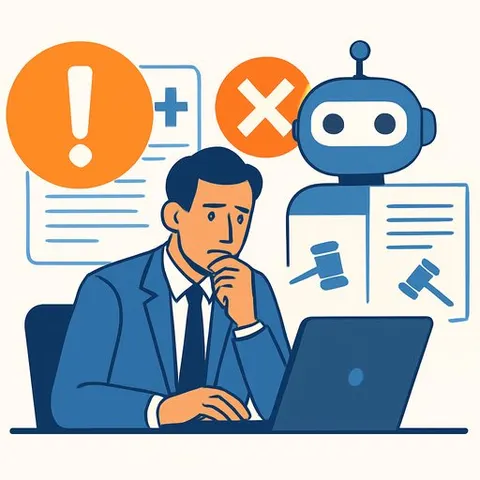
An audit of 1,000 hours of AI-generated court and medical transcripts found critical errors in 18% of documents. The mistakes included incorrect medication dosages, altered testimony and missing negative modifiers like "not." Such errors can change clinical decisions and legal rulings, raising urgent questions about automated transcription in healthcare.
How AI gets transcription wrong
Generative AI systems do not simply convert speech to text. They predict words based on patterns, which can introduce factual errors known as hallucinations. These errors often occur because the model lacks the contextual understanding a human listener would bring.
Ben Walker, CEO of Ditto Transcripts, said AI systems can perform impressively in controlled environments but often struggle when confronted with real-world conditions. Courtrooms and hospitals rarely provide pristine audio. Multiple speakers may talk at once, accents vary, and technical terminology is dense.
The audit identified three recurring problem areas:
- Overlapping speech leading to misattributed statements
- Specialised legal and medical terminology replaced with similar-sounding common words
- Omission of negative modifiers such as "not," creating the opposite meaning
These failures are not just typographical. A missing "not" can turn a critical safety warning into an affirmative statement. For Speech-To-Text tools used in high-stakes settings, that level of error is unacceptable.
Healthcare's growing reliance on AI scribes
Healthcare organisations have moved quickly to adopt AI scribes that promise to cut paperwork and ease administrative burdens. Canadian studies suggest these tools can dramatically reduce the time clinicians spend on documentation. Yet the same speed that improves workflow can also omit clinical nuance.
When a patient encounter is summarised by an AI, the output may miss an allergy reference, alter a dosage, or flatten a clinician's spoken concern into a generic note. Canadian privacy experts have flagged several risks: transcription inaccuracies, consent management gaps, data residency questions and the protection of personal health information. Several provincial privacy commissioners now require human review of AI-generated clinical documentation.
These concerns are amplified by the fact that many AI transcription services process data in the cloud. Sensitive health records may pass through external systems, raising compliance questions under federal and provincial privacy laws. Organisations must evaluate how vendors store, process and potentially reuse that data.
Legal systems face parallel risks
Court transcripts serve as official records that underpin appeals and case preparation. A mis-transcribed testimony or omitted statement can alter the interpretation of evidence and create grounds for legal dispute. Generative AI systems, unlike earlier speech-to-text software, infer language patterns and fill gaps. That can improve readability but also introduce meaning that was never spoken.
For this reason, legal technology specialists continue to recommend verification by trained transcription professionals. The same principle applies in AI for Healthcare: the technology can accelerate documentation, but a human must validate accuracy and context.
Why this matters for healthcare professionals
AI transcription can reduce the time you spend on charting, but the output is not a finished clinical note. An incorrectly transcribed prescription, a missing negative modifier or an omitted allergy can directly affect patient safety. Treat the AI-generated draft as a starting point, not the final record.
Organisations should implement a human-in-the-loop review process that checks for context, accuracy and regulatory compliance. Before adopting any AI scribe, ask vendors how they handle consent, data residency and model training on your data. The efficiency gains are real, but the responsibility for the clinical record remains yours.