WiseTech's AI Restructure Puts ~2,000 Roles at Risk: What HR Needs to Do Now
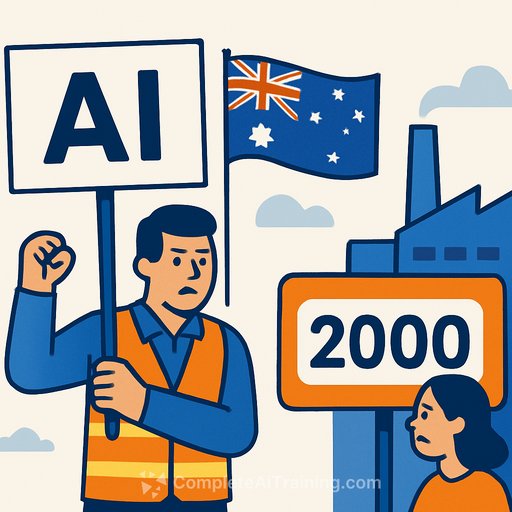
WiseTech Global plans a two-year restructuring tied to AI that could affect about 2,000 jobs - roughly 29% of its 7,000-person workforce across 40 countries. Professionals Australia, the union representing tech and engineering workers, has called for an urgent meeting and formal consultation with the company.
The union says WiseTech must provide written detail on how AI will be deployed, the impact on roles, and steps to avoid or reduce redundancies. As the union's Paul Inglis put it, "The introduction of AI on this scale is clearly a major workplace change," which triggers transparency, consultation, and real consideration of redeployment and retraining.
Why this matters for HR
This isn't a routine restructure. It's AI changing job design, workflows, and capability needs across multiple regions. HR has to lead on lawful consultation, fair selection, and a credible plan to reskill and redeploy - under time pressure and public scrutiny.
Immediate actions for HR leaders
- Map the change: Identify roles, teams, and regions touched by each AI deployment. Link each impact to a specific system or process change.
- Activate consultation: Share written detail on the change, likely effects, and measures to avoid/reduce redundancies. In Australia, review consultation obligations for major workplace change (see Fair Work guidance).
- Stand up a cross-functional SWAT team: HR, Legal, ER/IR, Data/AI leadership, Security, Comms, and Regional HR. Give them a daily operating rhythm.
- Freeze non-critical changes: Reduce noise. Prioritize decisions that protect people, service, and compliance.
- Centralize documentation: One source of truth for role maps, selection criteria, skills data, and redeployment opportunities.
What to disclose in consultation
- Which AI systems are being implemented, where, and when.
- Expected changes to tasks, role counts, and locations.
- Selection methods for role changes and redundancies.
- Alternatives considered: vacancy freeze, attrition, hours change, retraining, redeployment.
- Timeframes, support, and appeal or review mechanisms.
Fair selection and alternatives
- Selection criteria: Use job-related, validated, and consistent criteria. Document decisions and moderation steps.
- Redeployment matrix: Match at-risk employees to open roles based on skills adjacency, not just current titles.
- Skills bootcamps: 4-8 week programs tied to specific AI-augmented roles (data quality, prompt design for ops, workflow automation oversight).
- Vendor-supported training: Leverage supplier enablement for the AI tools you're rolling out.
Design roles for an AI-enabled operation
- Task-level redesign: Split each impacted role into automated, augmented, and uniquely human tasks.
- New roles: AI operations lead, automation controller, data stewardship, exception handling, and customer escalation specialists.
- Guardrails: Human-in-the-loop checkpoints for safety, compliance, and customer outcomes.
Global and legal coordination
- Country-specific consultation rules, notice periods, and severance formulas differ. Build a jurisdiction matrix and get local counsel sign-off.
- If works councils or unions are involved, align timelines and document every engagement.
- Maintain equal opportunity standards across regions. Audit for adverse impact.
Communication cadence that preserves trust
- Sequence: Leaders first, managers second, then impacted employees, then all-hands, then external.
- Manager toolkits: FAQs, talk tracks, role-specific impacts, and "what happens next."
- Repeat and update: Weekly pulse notes, even if there's little change. Silence fuels rumors.
Support and fairness for impacted employees
- Transparent severance and benefits, stated in writing.
- Career transition support: CV coaching, interview practice, referrals, and job fairs with hiring partners.
- Mental health resources and protected time to use them.
Data you need on day one
- Skills inventory by person and role. Include certifications, projects, and tools proficiency.
- Live vacancy list with required skills and location flexibility.
- Training catalog mapped to AI-augmented roles and proficiency targets.
- Automation impact model: tasks removed, tasks augmented, quality/safety controls.
Governance and metrics
- Governance: An AI Change Board to approve role changes, training, and controls. Keep minutes.
- KPIs: Redeployment rate, training completion and proficiency, time-to-placement, quality and customer metrics post-go-live, and complaint/appeal rates.
- Post-implementation review: 30/60/90-day checks for unintended effects and bias.
If you're building the reskilling plan
- Target roles where 30-50% of tasks are automatable but the role still needs a human.
- Teach workflows and judgment, not just tools. Anchor training to live use cases.
- Assess into roles with practical evaluations, not only quizzes.
Level up your HR AI capability
If you need a structured path to lead AI change, this resource helps with strategy, analytics, and talent planning: AI Learning Path for HR Managers.
Bottom line: AI is shifting work now. Treat this as a legal obligation and an opportunity to retain talent through smart redeployment and targeted training - with documentation that stands up to scrutiny.
Your membership also unlocks: