
AI news ·
Avaya and Avatarin deploy robots and AI to extend contact center services into physical spaces
Avaya and Tokyo robotics firm Avatarin are deploying human-sized robots in airports and government offices, letting remote specialists assist customers on-site via screen. AI handles translation and routine tasks while humans take complex cases.
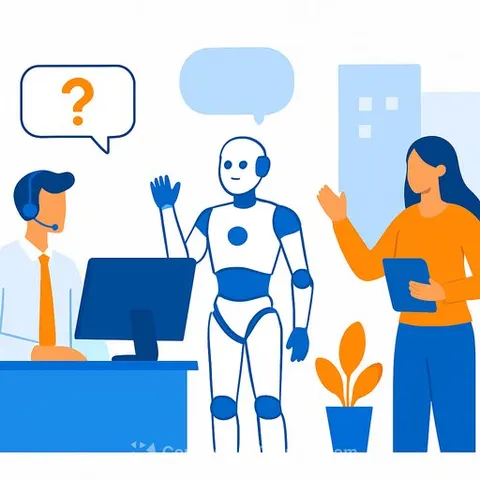
Avaya and Avatarin Deploy AI, Robots and Remote Agents to Fill Physical Service Gaps
A resident walks into a Tokyo municipal office needing help but speaks a language the staff doesn't understand. Instead of being shuffled between departments, he approaches a human-sized robot displaying a remote worker's face. That worker assists him in real time, with full access to his service history.
This scenario reflects a broader shift in how enterprises handle customer support. Avaya and Avatarin, a Tokyo-based robotics company, are using Avaya's CX platform to orchestrate interactions between AI systems, remote human agents and physical robots across airports, government offices and retail locations.
The Problem: Expertise Where It's Needed
Avatarin CEO Akira Fukabori calls the core issue "unmet presence"-situations where the right expertise is required in a physical location but isn't available on-site.
Enterprises have invested heavily in omnichannel customer experience systems for digital channels. Physical environments remain a weak point. Customers starting with in-person interactions often hit staffing gaps or language barriers, forcing them to repeat information or abandon the interaction entirely.
Jon Arnold, principal of J Arnold & Associates, said the challenge is straightforward: "Enterprises have spent years unifying digital interactions, but the physical world remains disconnected."
How the System Works
The Avaya-Avatarin model combines three elements: AI agents that handle routine inquiries and translation, remote human specialists for complex issues, and physical robots that serve as conversational interfaces.
The key technical feature is context sharing. When a customer moves between an AI system, a remote agent and a physical space, their service history follows them automatically. This eliminates the friction of repeated explanations during handoffs.
Fukabori said data silos and handoffs between staff lacking specialized knowledge create the biggest friction points. The system uses interoperability standards to share customer context across enterprise workflows.
In Tokyo pilots, Avatarin's "newme" robot displays a remote specialist's face on a screen and moves deliberately to make interactions feel natural. "When the face responds naturally and the robot moves deliberately, users quickly adapt to it as a normal interaction," Fukabori said.
Why Both AI and Humans Matter
The deployment is not designed to replace human agents. Instead, AI and humans work in what Avaya calls "tandem care," where each handles what it does best.
AI excels at handling high volumes, responding quickly and executing routine tasks. Humans excel at empathy and complex decision-making. Fukabori said: "Agentic AI excels in scalability, responsiveness and task execution. However, empathy and complex decision-making remain the domain of humans."
Tony Lama, Avaya's senior vice president and general manager of Software, and David Funck, Avaya's CTO, said the platform is designed with governance and deployment flexibility to unify AI, data and communications across hybrid environments.
What This Means for Support Teams
For customer support professionals, this model changes how work gets distributed. Remote specialists can now assist customers in physical locations without being present. Support staff in offices can focus on complex cases while AI handles routine requests and initial triage.
The shift also addresses real constraints: labor shortages, multilingual demand and pressure to resolve issues faster. Organizations can deploy expertise remotely rather than hiring locally for every location.
Arnold noted that success depends less on the hardware than on back-end integration. The real challenge is maintaining continuity as customers move between systems and environments.
Learn more about how AI for Customer Support and AI Agents & Automation are reshaping how support teams operate.