
AI news ·
Bangladeshi journalists use free artificial intelligence tools with human oversight to increase newsroom productivity
Global newsrooms embed AI into daily workflows. Bangladesh's journalists rely on free tools like ChatGPT without institutional policies, widening ethical risks.
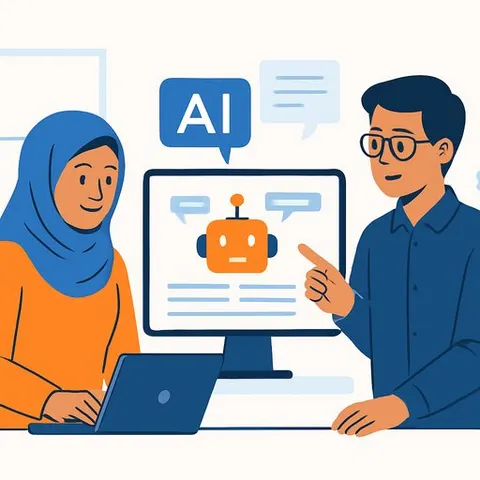
Global media organizations are embedding artificial intelligence into daily workflows to automate data-heavy reporting and routine tasks, but Bangladesh's newsrooms remain in an exploratory phase, relying on individual experimentation with free tools like ChatGPT and Google Translate rather than institutional strategies. This gap widens ethical risks and limits the cultural relevance of AI-assisted journalism.
Major outlets now use AI to scale coverage without draining human resources. The Associated Press deploys natural language generation platforms to automatically produce corporate earnings reports and minor-league sports briefs. Bloomberg uses proprietary large language models for financial document analysis and sentiment tracking. Semafor built a tool called Signals to search global news feeds, while the Financial Times and the Wall Street Journal use AI to predict trending topics and identify coverage gaps. BBC's internal generative AI models reformat local democracy stories into BBC house style and generate summaries and translations. In each case, AI handles time-consuming tasks, but journalists remain essential for verification, context, and editorial judgment.
AI's expanding role in major newsrooms
Rather than replacing reporters, these models act as smart assistants. They transcribe interviews, translate copy, draft early versions of articles, and free up professionals to pursue investigative work and complex storytelling. The key is that all output passes through human review, ensuring accuracy and tone.
Bangladesh's ad-hoc adoption
In Bangladesh, the picture is different. Most newsrooms lack dedicated R&D budgets and in-house engineering teams. AI use is bottom-up: individual journalists turn to Grammarly, Google Translate, or ChatGPT to proofread, rephrase, or translate copy under deadline pressure. Industry leaders at a media dialogue hosted at The Daily Star Centre pointed out that while AI tools are affordable, local organizations operate without formal, written AI editorial policies or self-regulating mechanisms. Editors at New Age newspaper said that when staff are trained to use generative tools, "the output frequently lacks the localized emotion, cultural nuance, and deep historical context required for impactful domestic journalism."
The risks: bias, deepfakes, and loss of context
Misinformation and Deepfakes: Credible-looking fake text, images, and video can now be produced at scale. Without rigorous verification, newsrooms risk amplifying state propaganda, corporate manipulation, or AI-invented facts.
Training Data Bias: Standard AI models are trained mostly on Western-centric datasets, carrying inherent linguistic, cultural, and political biases. They often misinterpret the historical and socio-political nuances of countries in the Global South, leading to skewed coverage. Human oversight is mandatory at every stage to catch these errors before publication.
A practical workflow for writers
Writers can chain free AI tools to improve productivity while maintaining full control. Start with research: use Google search or its AI mode to collect sources and select five to ten trustworthy pieces. Feed them into Google's NotebookLM, which builds a knowledge base strictly from the supplied documents, reducing the chance of hallucinated data. Ask it to pull out relevant information and draft a structure. Then move to Gemini and create a custom assistant-a "gem"-designed to write based on that outline. After the gem produces a draft, edit and polish it manually before sending it for sub-editing. This keeps the writer in the loop at every step, ensuring the final copy holds the necessary nuance and accuracy.
Why this matters for writers
For writers, AI is not a replacement for skill but a multiplier of speed and reach-provided it is used with strict verification. The real danger is treating these tools as final drafts. By building a workflow that combines multiple free tools under human supervision, writers can produce more work while preserving the voice, context, and factual integrity that algorithms alone miss. For those ready to explore these methods, resources on AI for Writers offer practical guidance on integrating generative tools into professional practice.