
AI news ·
Bernie Sanders proposes a 50% stock tax on large AI companies to create a $7 trillion public wealth fund
Bernie Sanders introduced a bill to seize 50% of the largest U.S. AI firms via a one-time stock tax, creating a $7 trillion public fund. The plan would pay over $1,000 annually to every American and give a government commission voting power over corporate decisions.
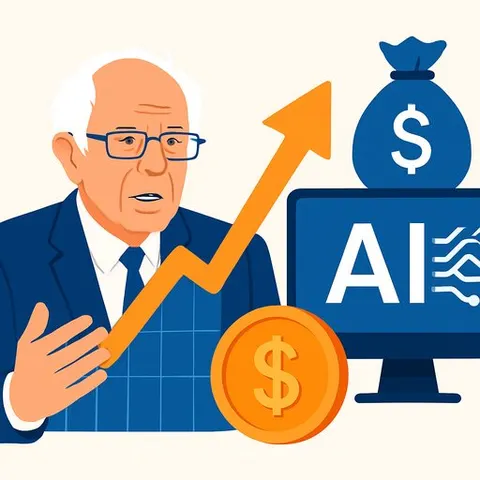
Sen. Bernie Sanders introduced legislation Wednesday that would seize 50% ownership of the largest U.S. artificial intelligence companies through a one-time stock tax, creating a sovereign wealth fund worth an estimated $7 trillion. The proposal, shared first with The Associated Press, would deliver annual payments exceeding $1,000 to every American while giving the public direct influence over corporate decisions at firms racing toward trillion-dollar valuations.
The bill targets AI companies with at least $200 million in annual AI sales. Rather than cash, those firms would transfer stock to a federally managed fund, making the American public a major shareholder. A seven-person independent commission - nominated by the president and confirmed by the Senate - would control the voting shares and direct a 5% annual dividend back to citizens. Gains beyond that dividend would fund public programs including education, housing and healthcare.
"The benefits cannot simply go to the handful of wealthy corporations. They will be shared by the American people," Sanders said in an interview. The Vermont independent framed the legislation as a counterweight to concentrated industry power. "The public has got to have a significant seat at the table to make sure that terrible things do not happen to ordinary people, and that in fact, AI benefits ordinary people, not hurts them."
A public stake gains bipartisan attention
Sanders is not alone in pushing for public ownership of AI firms. President Donald Trump has mused about government stakes in AI developers, saying recently that "there's something very interesting about it, where it almost becomes a partnership with the American public." OpenAI in April proposed creating a public wealth fund tied to AI-driven economic growth. Anthropic CEO Dario Amodei has written that universal basic income could be financed through taxes on relevant companies.
But Sanders' plan goes far beyond those ideas. He dismissed the smaller-scale proposals from industry leaders. "I think people like Sam Altman and Trump who may be sympathetic to this are saying: 'Okay, look, we're making zillions of dollars so we're going to be nice guys and maybe we'll buy off the public. We will give 5% of our profits back into the government,'" Sanders said. "That's not what we're talking about. What we're talking about are two very different things."
Stock tax, not cash
The mechanism differs from a traditional corporate tax. Companies would transfer equity rather than cash, which Sanders argues protects taxpayers from downside risk. "We're not going to lose any money, even if there is a bust in the bubble," he said. The commission would use its voting power "to block decisions that hurt the American people and to push for policies that help them," according to the bill summary. Any new AI company crossing the $200 million sales threshold would also become subject to the tax.
Economic anxiety drives the message
The proposal lands as public unease about AI grows. About 70% of college students see artificial intelligence as a threat to their job prospects, according to a 2025 Harvard Kennedy School poll. Data center projects have drawn local opposition over electricity demand and water consumption. States including Ohio and Virginia have moved to reconsider tax incentives for the facilities. Sanders said he plans to make AI ownership and wealth inequality central to his "Fighting Oligarchy" message on the campaign trail. "Workers will be thrown out of their jobs while billionaires, multi-billionaires become even richer," he said. "The American people are aware of that and don't want to see it happen."
Why this matters for government and IT professionals
The legislation, if enacted, would fundamentally alter the ownership structure of firms that supply AI infrastructure to federal agencies and contractors. Government IT managers and developers working on procurement, model deployment, or data center operations would face a new stakeholder: a commission with voting power over corporate strategy, pricing, and product roadmaps. The fund's mandate to block decisions that hurt the public could affect everything from model licensing terms to the environmental permitting of data centers. Even if the bill does not pass in its current form, the level of political attention signals that public ownership frameworks are entering serious policy discussions - and that workforce displacement concerns are shaping legislative appetite faster than many in the industry anticipated.