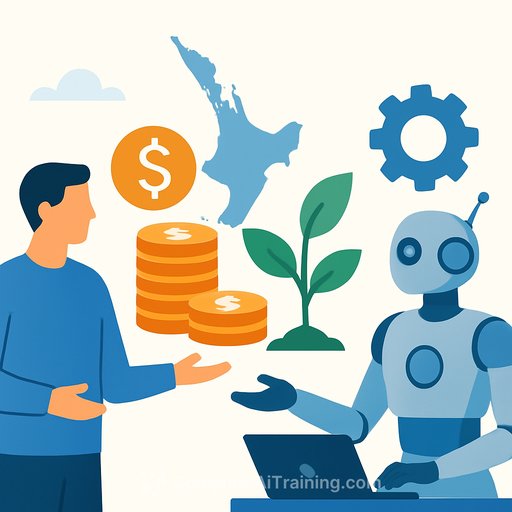
AI can help the government spend billions better - with humans firmly in charge
New Zealand spends about NZ$51.5 billion a year-around 20% of GDP-buying goods, services and infrastructure. That spend builds hospitals and bridges, secures defense and medical supplies, funds cloud systems and renewable energy, and keeps essential services running.
How we spend is as important as how much. The latest Government Procurement Rules ask agencies to support local jobs, Māori and Pasifika businesses, fair labor, lower emissions and circular materials. The intent is clear; the execution is hard.
The opportunity: smarter spend, better outcomes
Procurement can drive economic and environmental benefits at scale. One contract can create quality jobs, strengthen local supply chains and reduce emissions.
The problem is signal overload. Sustainability data is buried across reports and supplier claims. Many teams don't have the time, tools or specialist knowledge to sort it out in a live tender.
Where AI can add real value across the procurement cycle
- Planning: Analyze past spend to forecast demand, pinpoint high-emission categories and identify cleaner alternatives (e.g., shifting vehicle fleets to low-emission options).
- Tender design: Draft clear, outcome-based criteria and intelligent supplier questionnaires that test real sustainability performance, not just marketing claims.
- Supplier due diligence: Cross-check certifications, flag environmental or labor violations, and surface anomalies or exaggerated "green" claims for human review.
- Evaluation: Score proposals against price, quality and sustainability factors using consistent rubrics, with explainable reasoning for every score.
- Contract management: Track performance data in near-real time, alerting teams when targets (emissions, waste, fair labor standards) are at risk and recommending corrective actions.
- Integrity and savings: Tools like "Alice" in Brazil scan contracts for irregularities and have reportedly saved over US$1 million-proof that oversight and efficiency can move together.
Why guardrails matter
AI isn't plug-and-play. Bias from skewed or incomplete data can disadvantage smaller local suppliers. A high-profile example: the Dutch child-benefits system wrongly flagged thousands of families, many from migrant backgrounds, with severe consequences.
Opaque "black box" models undermine accountability. Data privacy, security and the energy footprint of large models are real concerns. Without checks, the tool can work against the outcomes we want.
What "responsible AI in procurement" looks like
- Human in the loop: AI supports; people decide, especially on supplier selection and contract remedies.
- Explainability: Every recommendation needs a clear reason you can share with suppliers, auditors and the public.
- Bias testing: Regular audits for disparate impact on SMEs, Māori and Pasifika businesses, and regional suppliers-fix issues fast.
- Fair access: No lock-in. Avoid vendor terms that block competition or make exit costly.
- Data governance: Use reliable, permissioned data; protect sensitive commercial information and personal data.
- Greener compute: Prefer efficient models, right-size workloads and request energy/transparency reporting from vendors.
A practical rollout plan for agencies
- Start small: Pick one category (e.g., fleet, ICT peripherals, facilities) with clear sustainability levers and measurable outcomes.
- Define success up front: Emission reduction targets, SME participation rates, on-time delivery and cost avoidance-not just "AI used."
- Choose transparent tools: Require documentation of data sources, model logic, limitations and withdrawal rights.
- Build capability: Train buyers to read model outputs, challenge assumptions and run fair evaluations.
- Set governance: Establish approvals, audit trails and issue-resolution pathways; log every AI-assisted decision.
- Engage suppliers: Share criteria early, explain how sustainability will be assessed and offer feedback post-award.
KPIs that keep everyone honest
- tCO₂e reduced per contract and across the category.
- Share of spend with local SMEs and Māori/Pasifika businesses.
- Verified fair labor compliance rates and audit closure times.
- On-time, on-budget delivery alongside sustainability targets met.
- Cost avoidance from risk flags and anomaly detection.
- Percentage of AI recommendations accepted, challenged and overturned-with reasons.
Bottom line
AI can help public buyers move faster, see risks earlier and choose suppliers that deliver better economic, social and environmental results. But it only works if humans stay in charge, the models are transparent and the metrics are real.
Use AI to strengthen judgment, not replace it. That's how every public dollar stretches further for people, communities and the planet.
Upskill your team
If your agency is building AI capability for procurement, start with focused training on evaluation, prompts and oversight. See curated options by role here: Complete AI Training - courses by job.
Your membership also unlocks: