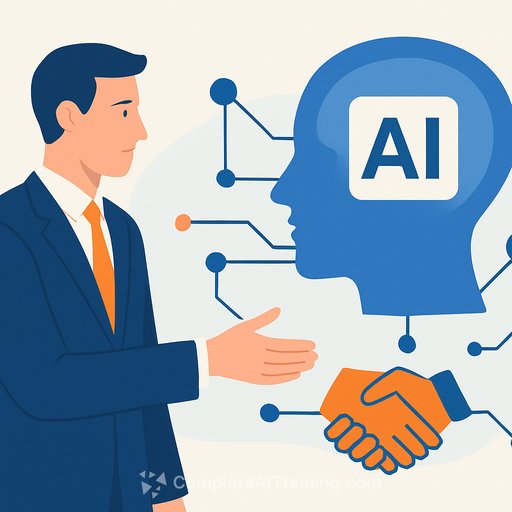
Trust, Not Technology Speed, Drives AI Transformation
Glenn Remoreras, EVP and CIO at Breakthru Beverage Group, says most organizations get AI adoption backwards. They focus on tools, skills, and process redesign while overlooking what actually makes transformation stick: trust between business and technology leaders.
"As AI accelerates change, the real differentiator for leaders will no longer be how fast they move, but how deeply they connect," Remoreras said.
The distinction matters because AI isn't a technology problem to solve in isolation. It changes decision-making, work design, customer experience, risk, and how employees understand their roles. When business and technology leaders approach AI from opposite sides of the table, adoption stalls.
The IT-Business Gap That Never Closes
In most organizations, business functions treat IT as a service provider. Technology leaders reinforce this by referring to business stakeholders as "customers." The language reflects a deeper structural problem: IT receives strategy, translates it, and executes it. The relationship stays reactive.
Remoreras has spent years trying to solve this chasm. The alternative he advocates is convergence, where business and technology leaders are equal partners. CIOs shape strategy rather than simply respond to it, bringing clear understanding of what technology capabilities, data, and AI can make possible.
"When trust exists, technology strategy becomes inseparable from business strategy," he said. That shift is essential for AI because the technology touches every function and every decision.
Trust as Infrastructure
Remoreras treats trust as core operating infrastructure, not a soft skill or leadership accessory. AI introduces uncertainty across multiple levels: employees wonder how their work will change, leaders struggle to separate hype from real opportunity, and functions disagree about ownership, risk, and funding.
Without trust, those tensions harden into resistance. With trust, they become productive.
His thinking draws from the Business Relationship Management discipline, which he helped develop as an early founding member of the BRM Institute in 2014. But he sees relationship management not as a dedicated role but as a leadership capability that should span both technology and business functions.
The PATH Framework
Remoreras developed a framework called PATH to describe the leadership capabilities organizations need in an AI-enabled world:
- Purpose: People need to understand why the work matters. Purpose creates alignment and gives people a shared reason to move through uncertainty.
- Agility: The ability to lead when the path is still forming. It's about setting rhythm and empowering others, not controlling every decision.
- Trust: The currency of leadership in the age of AI. It's the safety net that allows people to explore boldly and experiment without fear.
- Humanity: When employees sense leaders value technology more than people, they disengage. Innovation anchored in ethics, empathy, and fairness builds confidence.
What This Means for CIOs
Technology leaders are accountable for the platforms that make AI possible, but they're also positioned to shape the relationships that make AI scalable. CIOs can help organizations move from IT as service provider to technology as co-leader, build connective tissue between strategy and execution, and create conditions where business and tech leaders share ownership.
As machines become more capable, the leadership capabilities that can't be automated become more valuable. The ability to listen, align, challenge, empathize, and lead through ambiguity is a strategic advantage.
The organizations that win with AI won't necessarily be those that choose the right platforms or move the fastest. They'll be the ones that build enough trust for people to move together.
For more on AI strategy and leadership, explore resources for AI for Executives & Strategy and the AI Learning Path for CIOs.
Your membership also unlocks: