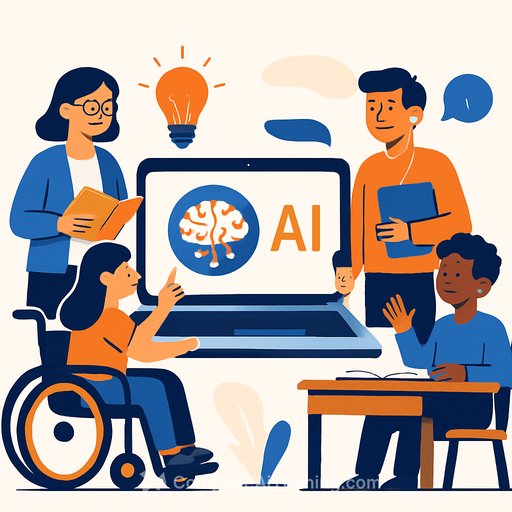
AI + Learning Differences: Designing a Future with No Boundaries
A recent white paper from the Stanford Accelerator for Learning highlights the potential of artificial intelligence (AI) to support students with learning differences—if built with their needs and voices at the center. This report stems from a two-day Working Symposium and Hackathon that gathered more than 100 participants, including students, educators, researchers, entrepreneurs, policymakers, education leaders, philanthropists, and many individuals with learning differences themselves.
On the first day, attendees engaged in collaborative discussions about AI and learning differences. The second day focused on designing and testing new tools that could make a real difference in educational settings.
Prioritizing Inclusion in AI Design
The event embraced the disability rights principle, “nothing about us without us,” stressing that people with lived experience must be central to creating emerging technologies. As AI becomes more embedded in education and daily life, the group reflected on whose needs AI systems serve—and whose are overlooked. Conversations covered how AI might better identify when students need extra support, enhance assistive technologies, and improve Individualized Education Plans (IEPs).
They also considered AI’s impact on students’ social and emotional well-being, and whether AI can be programmed to recognize diverse forms of intelligence beyond traditional academic standards.
The white paper, released on July 21, synthesizes these discussions and outcomes. It presents a vision for an AI-driven future that includes all learners and offers 12 practical recommendations for developers, educators, researchers, and policymakers to ensure AI serves learners equitably.
Inclusive Design Benefits Everyone
Creating AI with the needs of people with disabilities in mind enhances the experience for all learners. For example, real-time captioning helps not only hard of hearing students but also English language learners and those with auditory processing challenges. AI tools supporting executive functioning can assist office staff managing day-to-day logistics.
Starting with accessibility leads to smarter, more adaptable systems that serve a broad range of users.
As one participant noted, designing for the full spectrum of human experience exposes gaps affecting many learners, including multilingual students, those with limited resources, or simply different learning styles. Inclusive design isn’t a limitation—it’s a catalyst for better technology and stronger educational equity.
Key Recommendations
- Co-design AI tools with individuals who have learning differences
- Provide professional development for educators on equitable AI integration
- Foster cross-sector collaboration to create inclusive policies and funding
- Prioritize privacy, transparency, and student agency in AI systems
The white paper is accompanied by a Hackathon Toolkit to help schools, companies, and community organizations develop inclusive AI tools alongside students, families, and educators.
Changing Perspectives on Disability and Learning
Seventh-grade student Mae T., who served as a hackathon judge, shared an important insight: “In many schools, disability is seen as a problem, and teaching focuses on ‘fixing kids.’ I have seen that at my school. But at the meeting, I realized the real issue is our ideas about disability. Teaching should focus on changing how we think about learning differences, because everyone learns differently.”
For education professionals eager to explore AI’s potential in inclusive learning environments, resources and courses are available at Complete AI Training. These offer practical guidance on integrating AI tools thoughtfully and equitably in education settings.
Your membership also unlocks: