The Era of AI Agents
The era of AI agents is here, changing how businesses operate. From customer service chatbots that resolve complex issues to sales agents that nurture leads autonomously, AI agents have become essential in many operations. Central to their success is a concept that many companies have developed over the years: the Customer 360 (C360).
What started as a tool for marketing personalization and customer insights has now become the critical data backbone powering AI agents. Whether your AI initiatives thrive or fail depends largely on the quality and design of this data spine.
The C360: From Marketing Tool to AI Agent Foundation
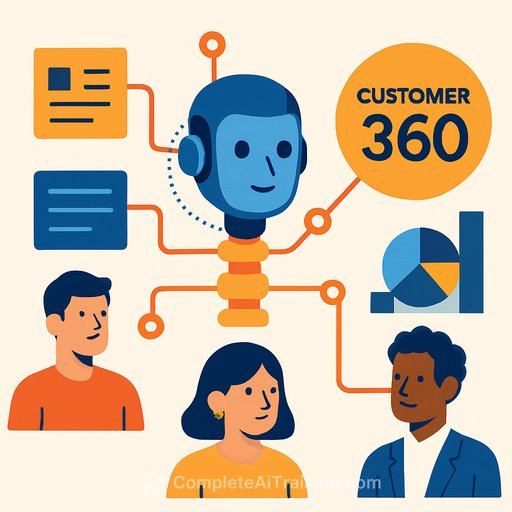
Traditionally, the Customer 360 offered a unified view of customer interactions, preferences, and behaviors across all touchpoints. Marketing teams used it for personalization, sales teams for prospect insights, and customer support for better context. Today, this unified customer profile acts as the central nervous system for AI agents.
Just like a Customer Data Platform (CDP) creates a single source of truth for humans, the C360 now serves as the foundational layer enabling AI agents to make smart, contextual decisions in real time. It must gather, clean, and organize not only customer data but all relevant enterprise data to provide comprehensive context.
Why AI Agents Demand More Than Raw Data
Enterprises have vast amounts of data—customer interactions, transactions, product info, support tickets, sales conversations, and more. But AI agents don’t just need data; they need the right data, in the right format, at the right time.
Unlike humans who can intuitively sift through irrelevant details or make decisions with incomplete information, AI agents depend strictly on their data architecture. Without a well-structured C360, an AI customer service agent might lack vital context like previous escalations or communication preferences, leading to poor customer experiences.
With a comprehensive C360, AI agents access full customer context—purchase history, support patterns, preferences, escalation triggers, and predictive insights—allowing them to deliver knowledgeable, personalized service.
The Data Engineering Challenge
Creating a C360 that supports AI agents requires serious data engineering. It’s not just about collecting data from multiple sources; it’s about building a real-time data structure that ensures agents have access to accurate, relevant information.
Data Integration at Scale
Data comes from many places: CRM systems, marketing tools, e-commerce platforms, support systems, mobile apps, IoT devices, and third-party sources. Combining all this requires advanced ETL processes, API integrations, and streaming data capabilities.
Data Quality and Governance
AI agents interpret data literally. Poor data quality—duplicates, inconsistent formats, missing or outdated info—directly harms their effectiveness. Enterprises must implement strict data quality measures, including automated cleansing, validation, and continuous monitoring.
Real-Time Processing
AI agents often need real-time or near-real-time data. For example, a chatbot interaction should instantly update the customer profile, influencing future conversations. This demands streaming data architectures and event-driven processing.
Contextual Data Modeling
The C360 must include more than basic customer data. It should capture interaction histories, behavior patterns, preferences, risk assessments, and predictive scores. Data models must support AI agent reasoning and decision-making, requiring a different design approach than traditional models.
Beyond Customer Data: The Enterprise Data Spine
The AI agent data spine extends beyond customer data. AI agents in sales, marketing, operations, or support need access to product info, inventory, pricing, policies, competitive intelligence, and operational metrics.
This broader scope demands a comprehensive enterprise data architecture that unifies high-quality, real-time, contextual data across many domains. For instance:
- Product recommendation agents require real-time inventory and pricing data.
- Sales agents need lead scoring, competitive insights, and territory details.
- Support agents access knowledge bases, escalation protocols, and service-level agreements.
The AI agent data spine must deliver all this seamlessly.
Preparing Your Data for the Agentic World
Waiting until AI agents are ready to deploy puts organizations behind those who build their data foundations early. Here are key steps to prepare your data:
- Audit Your Current Data Architecture: Assess your data sources, quality, and integration. Identify gaps that could hinder AI agents.
- Establish Data Quality Standards: Set rigorous standards for AI use, including format consistency, validation, completeness, and accuracy.
- Implement Real-Time Data Processing: Invest in streaming and event-driven data systems to keep AI agents updated instantly.
- Design for AI Agent Consumption: Build your C360 with AI use cases in mind. Create data models and APIs that support intelligent decision-making.
- Build Comprehensive Data Governance: Ensure data quality, security, and compliance with controls like access management, audit trails, and privacy safeguards.
- Create Contextual Data Layers: Add behavioral models, preference frameworks, risk assessments, and predictive insights to enrich AI decisions.
- Establish Feedback Loops: Let AI agents improve the data spine through their interactions, creating a cycle of continuous improvement.
- Plan for Multi-Agent Scenarios: Design data systems to support multiple AI agents simultaneously, managing consistency and conflict resolution.
The Strategic Imperative
Success with AI agents depends on seeing the C360 as more than a customer data hub. It must be an intelligent automation foundation. Just as companies invested heavily in ERP systems to standardize processes, they must now invest in advanced data architectures for AI.
Organizations with well-designed C360 systems will deploy AI agents that improve customer experience, boost efficiency, and adapt quickly. Those with weak data foundations risk inconsistent AI performance and frustrated customers.
This shift is one of the biggest technological changes in years. The quality of your data infrastructure—not just the AI models—will determine your success. Building an effective AI agent data spine requires significant effort but is essential for competing in an AI-driven market.
For those in customer support roles looking to sharpen their AI skills and understand more about data-driven AI tools, exploring practical AI training courses can be valuable. Check out resources at Complete AI Training for courses designed to fit your role.
Your membership also unlocks: