C3.ai's Federal Momentum Builds: Can Government Demand Drive Growth?
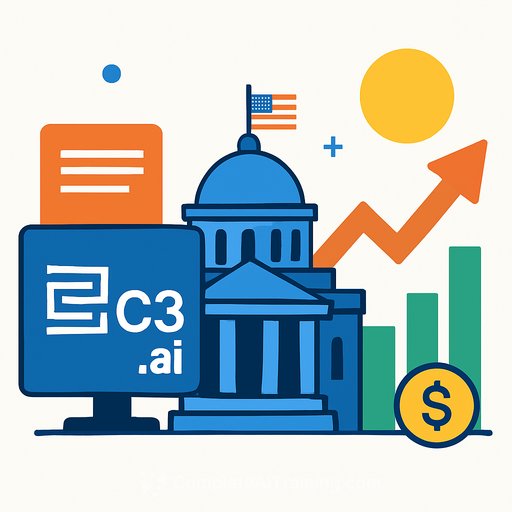
C3.ai reported a tough third quarter of fiscal 2026. Management called the results "clearly inadequate," citing missed closures in North America and Europe. Yet one area did stand out: federal, defense and aerospace. Bookings in this segment rose 134% year over year and made up 55% of total bookings.
What shifted in Q3 FY2026
- USDA: Selected C3.ai to unify data and automate analysis for intergovernmental and public engagement operations.
- DOE Headquarters Office of Management: Chose C3.ai to centralize and unify data, enabling an AI-driven decision platform for compliance oversight and operational visibility.
- NATO NCI Agency: Engaged C3.ai to support logistics planning and operations across 32 member states.
- Allied adoption: Reported uptake by Japan's Ministry of Defense and the UK Royal Navy.
The common thread: demand for secure, commercial off-the-shelf enterprise AI platforms that can support mission-critical operations. For public-sector leaders, this signals a shift from pilots and proofs of concept to platforms and outcomes.
Why this matters for government and defense leaders
The wins above map to high-stakes needs: unified data, faster decisions, auditability and logistics readiness. If your mission depends on timely, accurate decisions at scale, COTS AI platforms can compress time-to-impact-provided the fundamentals are in place.
- Authority to Operate and security: Confirm ATO status, FedRAMP posture and data handling controls. If cloud-based, verify boundary definitions and enclave options. FedRAMP can speed reviews.
- Data architecture: Require a clear plan to connect to existing systems, metadata standards, lineage, and role-based access. No clean, well-governed data-no value.
- Model governance: Demand versioning, bias testing, drift monitoring and human-in-the-loop checkpoints aligned with the NIST AI Risk Management Framework.
- DevSecOps integration: Ensure pipelines, IaC patterns and observability meet your agency's norms.
- Interoperability: Validate APIs, adapters and data exchange with existing ERPs, case systems and data lakes.
- Total cost and contract shape: Understand compute costs, seat vs. usage pricing, and support levels. Build in SLAs, milestone gates and exit ramps.
- Change management: Plan training, SOP updates and role design. Tools don't change outcomes-adoption does.
Market snapshot: performance, valuation and estimates
Shares of C3.ai are down 40.1% over the past three months, versus an 18% decline for the broader industry. Over the same period, TaskUs fell 7.6%, Leidos 4.8% and ServiceNow 33.3%.
On valuation, C3.ai trades at a forward price-to-sales of 4.51, below the industry average of 13.40. For context, TaskUs is at 0.79, ServiceNow at 7.23 and Leidos at 1.24.
According to the Zacks Consensus Estimate, C3.ai's fiscal 2026 loss per share has widened in the past 30 days, with projections calling for a 229.3% year-over-year earnings decline. By comparison, ServiceNow and Leidos are projected to grow earnings 17.7% and 3.1% in 2026, while TaskUs is expected to decline 3.1%. The stock holds a Zacks Rank #3 (Hold).
What this means for procurement and program risk
Execution issues and a weaker commercial book raise delivery and continuity questions, even as federal demand climbs. That doesn't mean "don't buy"-it means buy with guardrails.
- Use stage-gated contracts tied to delivered capability, not promises.
- Require performance SLAs for uptime, latency, model quality and data freshness.
- Add escrow or continuity clauses for critical IP, documentation and runtime artifacts.
- Plan a dual-path approach (primary and fallback vendor) for high-risk workloads.
- Track backlog conversion and referenceable go-lives before scaling agency-wide.
90-day action plan for agencies exploring enterprise AI platforms
- Weeks 1-2: Pick two priority use cases with measurable outcomes (e.g., case throughput, logistics readiness, compliance cycle time).
- Weeks 2-4: Run a data readiness sprint-access, quality, lineage, and security model.
- Weeks 3-6: Define pilot scope, KPIs and acceptance criteria. Lock SLAs and reporting.
- Weeks 5-8: Stand up the environment, integrate two systems of record, and baseline metrics.
- Weeks 8-12: Operate under real workload; report weekly on outcomes and issues; decide on scale-up or iterate.
Metrics that matter
- Time-to-insight or decision (before vs. after)
- Throughput: cases processed, tasks automated, alerts triaged
- Data quality: match rates, error rates, lineage coverage
- Model reliability: drift incidents, false positive/negative rates
- SLA adherence: uptime, latency, support response time
- Cost per outcome: compute and license spend per case or mission task
Bottom line
Federal, defense and allied demand for secure, enterprise AI platforms is building, and C3.ai is winning meaningful engagements. The catch is execution risk-particularly in commercial markets-and the need to translate bookings into delivered outcomes.
If you're evaluating platforms, protect the mission with strong governance, stage-gated contracts and clear KPIs. If the vendor delivers on federal programs at scale, you benefit. If not, your safeguards will.
Want structured guidance on public-sector AI adoption and operational rollout? Explore AI for Government and AI for Operations.
Your membership also unlocks: