AI and the Future of Marketing: Does Creativity's Definition Change?
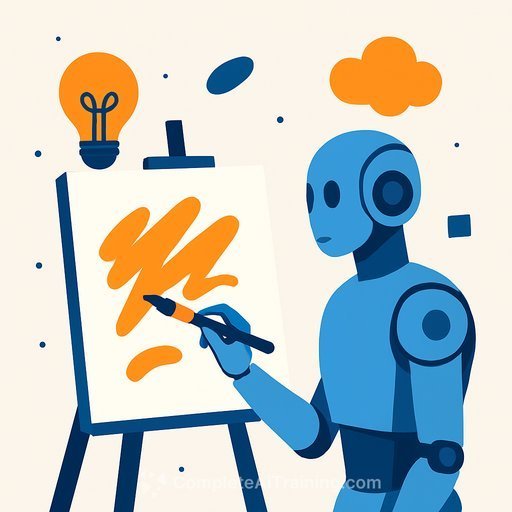
AI has moved from media buying and production timelines into the work that used to feel off-limits: writing, visual concepts, even the bones of a campaign. Efficiency was the hook. Now the question is bigger: what happens to creativity when machines start to create?
That's the core of an upcoming Newsweek webinar scheduled for March 10 at 1:30 p.m. ET, part of "The AI Agenda." The conversation features Suraj Srinivasan of Harvard Business School and David Sable, vice chairman of Stagwell-two voices tackling what AI means for imagination, not just workflow.
First, define "creative"
Srinivasan pushes on the starting point: what do we actually mean by creative work? Generative models can remix styles, merge genres, and spin out endless variations in seconds.
The hard question is whether remix equals originality. Replication can be sophisticated and useful. But is that the same as the leap that resets expectations?
The Da Vinci factor: rupture beats repetition
A Harvard Business School case study on Stagwell's AI strategy surfaces Sable's point with art history. Place a polished academic painting beside Monet's Impression, Sunrise and you feel it-the breakthrough doesn't look like what came just before it.
Sable extends it with The Last Supper in Milan. If an AI of that era had been trained on the frescoes of the day, it likely would have produced more Giovanni, not a leap to da Vinci. Whether AI can cross that threshold into true invention remains an open question.
Where AI is already changing the work
Both experts agree: the operational impact is here. One clear example is research. Synthetic personas-AI-driven, "living" audience profiles trained on real data-let teams simulate responses at a fraction of the cost and time of traditional persona studies.
When timelines compress by orders of magnitude, the production function of marketing shifts. Much of what leads to a creative outcome is repeatable process. The practical challenge: decide what AI should do-and what it shouldn't.
Your next moves as a marketing leader
- Pilot synthetic personas for early-stage concept testing. Use them to narrow options fast, then validate with small, real-world experiments before you scale.
- Build a creative operating system: prompt libraries, brand voice rules, asset QA, and version control. Treat models and prompts like production tools, not toys.
- Rewrite briefs for human × AI collaboration. Specify which parts AI drafts (variants, headlines, mood boards) and where humans provide judgment, taste, and constraints. Budget time for "weirdness" and serendipity.
- Install guardrails: approvals, bias checks, documentation, and disclosure policies. If you need a starting point, review the NIST AI Risk Management Framework for practical governance guidance here.
- Re-skill the team. Focus on data fluency, prompt craft, and model literacy. For ongoing practical coverage, see AI for Marketing and Generative AI and LLM.
Speed vs. soul
Sable has seen decades of technological shifts in advertising. The difference now: we're building at scale without shared guardrails. That puts more pressure on leaders to set standards before incentives set them for you.
As production accelerates, the human connection can get thin. Insight, taste, and empathy become the differentiators. If everyone can generate, the edge is knowing what to generate-and why.
What to listen for in the webinar
- Is creativity defined by recombination-or by the break from precedent?
- Can AI move beyond replication and surprise us on its own?
- How will roles in marketing evolve as more process work gets automated?
- What belongs to the machine, and what remains uniquely human?
The rise of creative machines could narrow imagination to what's already in the data-or open a new chapter in how we express it. The smart play is simple: run disciplined experiments, set strong guardrails, and protect the spark that turns strategy into something people actually feel.
Your membership also unlocks: