How viable is AI customer care?
Customer service is changing fast, and AI is the driver. Across the stack, teams are seeing faster resolution, shorter queues, and more consistent quality. A Bain & Company survey reports that 32% of AI projects in customer service have moved beyond pilots-a clear sign this isn't just experimentation anymore.
The big wins are practical. 24/7 chat, instant retrieval of knowledge, and AI-assisted agents who stay on-script without sounding scripted. As Andrew Leal, CEO of Waggel, notes, AI tools boost consistency in claims, guide next steps based on historical outcomes, and score sentiment across almost every interaction.
Quality assurance is getting a huge upgrade. "Traditional contact centres audit just one-to-three percent of interactions. But AI systems now enable 100% call and chat coverage with automated scoring and sentiment analysis," says Anshuman Singh, CEO at HGS UK.
The trade-offs you need to manage
AI can reduce headcount-four in ten business leaders say it already has, according to BSI. The smart move is a socio-technical approach: match the task to the channel. Quick, consistent issues go to AI. Complex, high-stakes, or vulnerable cases go to humans, with clear escalation paths.
Accent and identity masking: proceed with care
Some teams are testing tools that alter accents to sound "more local." The risk isn't just technical-it's cultural and ethical. Under the EU AI Act, people must be told when content is AI-generated or AI-altered, and deceptive practices can be flagged. See official guidance from the European Parliament here.
There's also the human cost. "Voice is integral to both personal and professional identity," says Singh. "Requiring employees to alter theirs-especially without genuine consent-sends a damaging message: that their natural speech is inadequate." If you even consider this tech, involve legal, ethics, HR, and your agents from day one.
From KYC to KYA: agent-to-agent is coming
Agentic AI is already replacing routine tasks, and a recent industry forecast suggests most common issues could be resolved by AI within the next few years, especially once agents can interact with each other. "We will see more interactions where agents speak to agents," says Livia Bernardini, CEO at Future Platforms. That shift requires brands to be interpretable and trustworthy to both humans and machines.
The most effective approach isn't a single mega-bot. It's a set of specialized agents with clear scope that hand off cleanly. As Simon James at Publicis Sapient notes, optimizing agent experience (AX) alongside customer experience (CX) captures more value-especially as agent-to-agent workflows grow.
Human-AI collaboration is the model
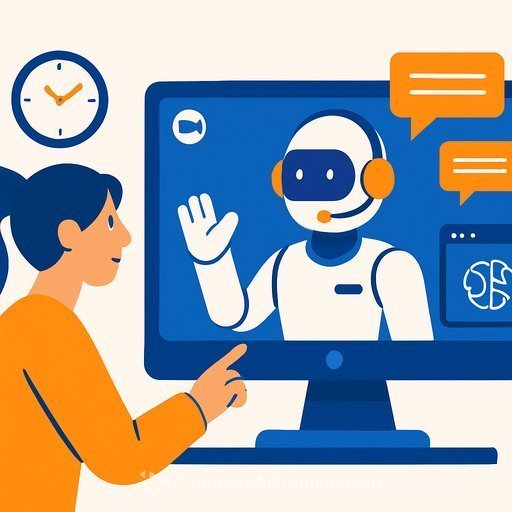
Expect an AI-first front door with a human safety net. Simple contacts flow through AI across voice and digital channels; high-value, high-risk, or vulnerable customers get humans supported by AI. That's the direction outlined by data leaders like Rohan Whitehead.
"AI will act as a 'copilot' for routine tasks and summaries, allowing agents to focus on complex problem-solving and empathy," says Singh. This only works if teams get AI literacy training. As Kate Field at BSI adds, agents need critical thinking to question outputs-otherwise decisions degrade fast.
Top risks in AI customer interactions-and how to mitigate them
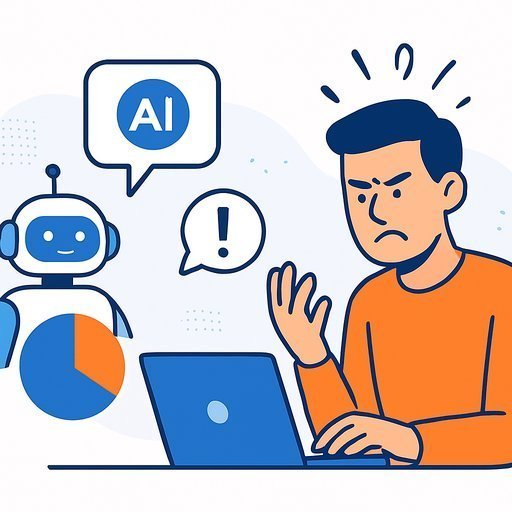
- Complexity and empathy failure: Bots break on ambiguous or emotional queries. Mitigate: provide fast, clear escalation to a human; use sentiment flags on frustration; test with varied edge cases before launch.
- Data privacy and security risks: AI systems handle sensitive voice, personal, and transaction data. Mitigate: apply privacy by design, federated learning where possible, strict data minimization, and end-to-end encryption/tokenization for voice and biometrics.
- Algorithmic bias and inconsistency: Historical data can encode unfair outcomes. Mitigate: run bias audits, track metrics like Disparate Impact Ratio, and retrain on balanced, curated datasets.
- High implementation and maintenance costs: Integration, retraining, and compliance aren't cheap. Mitigate: start with high-volume, low-complexity intents (FAQs, status checks) to pay back early.
- User trust and acceptance challenges: People want a human for sensitive issues. Mitigate: label bots clearly and always offer a quick route to a live agent.
Governance for vulnerable customers
Regulators expect accountability for AI outcomes under current rules like the FCA's Consumer Duty. Review guidance directly from the FCA here. Don't assume every customer knows how to "work" a bot. Older adults and other vulnerable groups may not.
Design accessibility in from the start: simple language, voice options, clear exits to humans, and callbacks that honor their time. Track outcomes for vulnerable cohorts and course-correct quickly if metrics slip.
Implementation playbook for support leaders
- Map intents by complexity, risk, and emotional load. Route low-risk to AI, high-risk to humans.
- Start with agent-assist and FAQ bots. Measure handle time, CSAT, containment, and escalation quality.
- Use sentiment analysis and expand QA from samples to near-100% coverage. Feed insights into coaching, not just compliance.
- Stand up governance: model cards, change logs, incident response, and regular red-teaming.
- Protect data: minimization, role-based access, strict retention, secret scanning, and audit trails.
- Design escalations that feel respectful: fast path to a human, warm transfers, and AI-generated summaries to cut repetition.
- Train teams on AI literacy and critical thinking. Update QA rubrics to reward empathy and outcome ownership.
- Review any accent/identity masking tech with ethics, legal, HR-and require explicit employee consent.
Upskill your team
AI raises the bar for customer support roles. If you're building AI literacy across your team, explore practical programs and AI Design Courses. Focus on skills that improve today's workflows: prompt quality, escalation judgment, data sensitivity, and outcome tracking.
The takeaway
AI customer care is viable-and valuable-when you pair automation with clear guardrails. The win is faster resolutions and more consistent outcomes without sacrificing empathy or accountability. Move in small steps, measure relentlessly, and keep humans in the loop where it matters most.
Your membership also unlocks: