
AI news ·
Canadian employers deploy AI agents faster than they can govern them
Two-thirds of Canadian organizations are piloting agentic AI, but 97% admit they are not fully prepared to deploy or govern it. Canadian employers expect to spend CA$39.4 million on AI this year, yet 46% have no human review process for AI-driven workforce decisions.
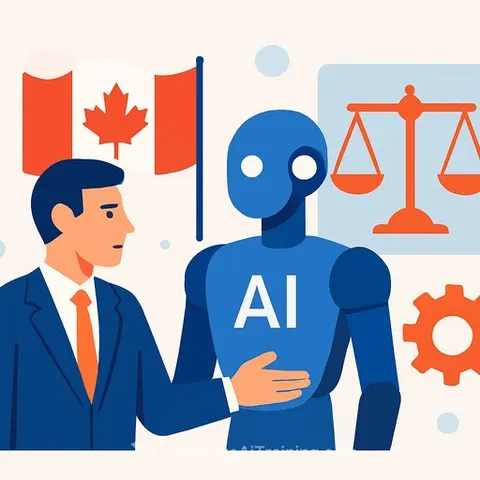
Two-thirds of Canadian organizations are already piloting agentic AI, yet 97% admit they are not fully prepared to deploy or govern it, according to a new SAP study that exposes a widening gap between AI adoption speed and workforce readiness. The research, conducted with Oxford Economics and surveying 200 Canadian leaders, arrives as HR teams face mounting pressure to manage autonomous software agents that make workforce decisions without constant human direction.
Canadian employers expect to spend CA$39.4 million on AI this year, projecting a 20% return on investment that nearly doubles to 38% within two years. But the path to those returns is rougher than anticipated: 64% of Canadian firms using agentic AI reported higher-than-expected integration effort, and 46% have no human-in-the-loop review process at all.
The governance gap nobody planned for
"The technology is ready. The challenge is getting the business ready for the technology," said Cathy Tough, Country Manager, SAP Canada, adding that AI without business context "creates activity without outcomes, and at worst introduces risk."
The numbers back her up. Data readiness is a weak link: 73% of Canadian organizations struggle with incomplete data despite 65% believing themselves data-ready. These are often the same employee records and workforce analytics that agentic systems act on. Globally, uneven AI literacy and weakened critical judgment rank as the top two workforce risks. More than half (56%) of Canadian organizations say staff use unapproved AI tools at least occasionally, a behavior tied to data leakage and IP exposure.
Anthony Robinson, Chief Technology Officer at SAP Canada, said governance must be built into how AI agents operate, not bolted on afterward. "This ensures that humans set the strategy while AI handles the orchestration and execution, all within a governed, auditable environment with humans in the loop at key moments."
Workforce transformation is lagging behind the tools
The SAP and Oxford Economics report found that 78% of businesses globally are unconvinced company-driven upskilling is keeping pace with AI's evolution. The same percentage doubt existing roles are changing fast enough to take advantage of AI-enabled workflows, leaving HR managing job descriptions that may already lag how AI is being used. Still, 79% agree maximizing AI's value requires transformation beyond technical upskilling, and 66% say soft skills are becoming core job requirements - a shift HR leaders must build into hiring and training.
For HR professionals navigating this shift, AI for Human Resources is no longer a future consideration. A separate report from People Managing People found that 21% of HR professionals report AI agents are already in use today, and 78% expect their organization to use at least one by the end of 2026. Chief human resources officers facing these governance gaps can explore an AI Learning Path for CHROs designed for executives who need to close the readiness gap while managing workforce risk.
Sean Kask, Chief AI Strategy Officer at SAP, described the bind clearly: organizations "face two challenges at once: risk that moves faster than most governance frameworks can keep up with, and value that is harder to measure than expected."
Canada versus the U.S.: a widening expectations gap
The broader SAP Value of AI report, which surveyed 2,600 leaders across 13 countries, found American employers posting the strongest AI returns of any market studied. U.S. respondents project US$9.9 million in ROI this year, rising to US$26.5 million in two years - both above the 13-country average. Canada sits closer to that global average, with US$5.8 million in ROI expected this year climbing to US$15.5 million in two years, on AI spending of US$28.4 million.
Canadian units of U.S.-headquartered employers may face pressure to match American targets without matching workforce-planning maturity. Worldwide, agentic AI ROI expectations jumped from 10% to 17% this year and are set to quadruple in dollar terms within two years, yet only 3% of businesses globally call themselves fully prepared to deploy and scale AI agents.
Why this matters for HR professionals
HR teams are now on the hook for governance decisions that were unimaginable two years ago. When nearly half of organizations have no human review process for AI agents that influence hiring, scheduling, or performance data, the compliance and fairness risks land squarely on HR's desk. The research makes clear that closing the gap requires more than policy documents - it demands building governance into the AI workflow itself, auditing data readiness now rather than after a breach, and redesigning roles and training around both technical and soft-skill requirements that the current job architecture doesn't reflect. The organizations posting the strongest returns are not the ones spending the most, but the ones that treated workforce readiness as a prerequisite, not an afterthought.