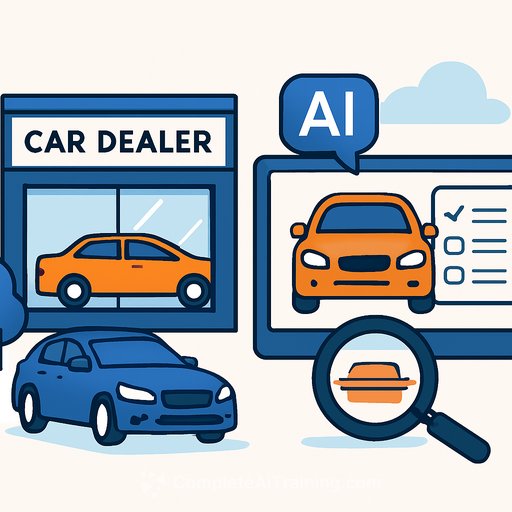
Dealers Don't Know How AI Describes Them to Customers - and That's a Problem
Car dealerships are being evaluated by artificial intelligence systems without any control over the narrative. When a customer asks ChatGPT where to buy their next car, the AI synthesizes an answer by pulling from your website, Google Business Profile, Better Business Bureau, DealerRater, Cars.com, and other online sources - then decides what to say about you, whether accurate or not.
Dave Spannhake, founder and CEO of Reunion Marketing, describes a scenario where someone asks ChatGPT about a specific dealership. The response could be: "Lawyer up. You're in for a wild ride." That verdict gets generated entirely by the AI, not by a customer clicking through search results.
"Not only do you want to be found, but you want to be found and talked about, [but] not like that," Spannhake said.
The Traffic Most Dealers Miss Entirely
With 700 million people on ChatGPT and LLM referral traffic up 550% year over year, the volume of AI-driven searches is real and growing. More critically, a significant share of those users make decisions inside the AI environment without ever clicking through to a dealership website.
Dealers tracking only website traffic are undercounting how many people form opinions about their store before arrival. "People are going to just make decisions in that platform altogether, so you look long term, people may not go to websites as often as they used to," Spannhake said.
Most Dealers Have No Baseline
When asked what dealers get most wrong about generative engine optimization (GEO), Spannhake pointed to the lack of measurement. Because AI responses vary from prompt to prompt, many dealers assume the results cannot be tracked.
Spannhake's team takes a different approach, running roughly 250 prompts daily across new, used, fixed operations, and reputational queries. At that volume, patterns emerge: where sentiment about a dealership is consistently positive, where it is consistently negative, and what sources drive each.
"If you're doing any marketing and you don't have a baseline for where you are, you can't set goals for where you want to go," he said.
Review Sites Beyond Google Now Matter
Most dealers have focused almost exclusively on Google reviews for years. That narrow focus creates blind spots.
ChatGPT and other platforms heavily cite DealerRater, Better Business Bureau, and Cars.com when generating responses about dealership experience. A dealer with weak scores on those platforms may have no idea those ratings are surfacing in AI answers.
"A lot of dealers have just been only doing Google for the last several years, and when you start looking at your prompt responses, you see, dang, my DealerRater reviews are pretty bad, and they're being talked about over and over again," Spannhake said.
SEO Standards Still Apply
AI platforms favor content that reads conversationally and is written for humans - the same standard strong SEO has always demanded. Review sites rank highly in AI citations precisely because the content is human-generated.
Dealers who have built specific, experience-driven content on their websites are better positioned in AI search than those who have not, regardless of whether they have thought about GEO at all.
"The goal is to make it as conversational as possible, write as a human would read it, because that's what these platforms are rewarding," Spannhake said.
What This Means for Sales and Marketing Teams
The shift requires a broader view of reputation management. Your team should monitor how AI systems describe your dealership across multiple platforms, not just Google. Start by running regular prompts to establish a baseline, then track changes over time to identify what's working.
For AI for Marketing Courses and deeper training on how these systems work, professionals can build the skills needed to optimize for AI visibility alongside traditional search.
Your membership also unlocks: