ChatGPT Nears Apple Health Integration: What Healthcare Teams Should Prepare For
Last updated: 12 hours ago
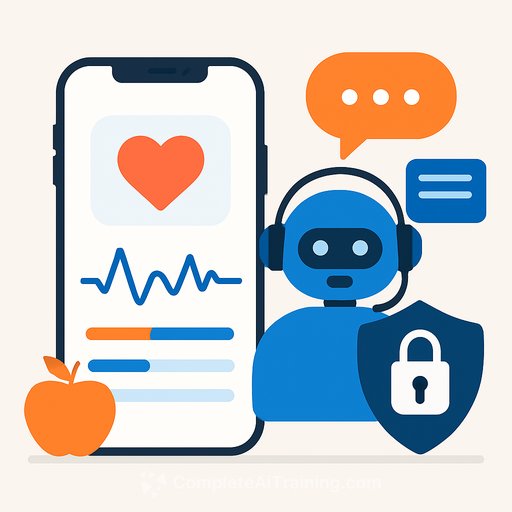
A recent app build suggests OpenAI is testing a direct connection between ChatGPT and Apple Health on iPhone. A hidden Apple Health icon and related filenames indicate the app could ingest health and fitness data and use it to generate more personal, context-aware responses.
If shipped, the option would likely surface in the "Apps & Connectors" section alongside services like Google Drive, Dropbox, and Slack. There is no public launch date yet.
What ChatGPT May Access From Apple Health
Early findings point to multiple data categories rather than a single metric:
- Physical activity and workouts
- Sleep patterns
- Nutrition
- Respiratory metrics
- Hearing health
That mix goes beyond step counts. It points to trend analysis across daily habits and biometrics, which could shape recommendations and summaries inside the chat interface.
Why This Matters for Clinical and Operational Teams
- Patient summaries: Potential to generate concise overviews from Apple Health data before visits.
- Adherence insights: Spot routine disruptions (sleep, activity, medication logs if present) that correlate with symptoms.
- Remote check-ins: Triage prompts for patients reporting changes in vitals or behavior.
- Education at scale: Auto-generate plain-language instructions that reflect a patient's recent patterns.
All of this still requires clinician oversight. ChatGPT can't replace clinical judgment or a comprehensive exam, and it may misinterpret edge cases.
OpenAI's Push Into Health
OpenAI appears to be building a more formal health strategy, including recent leadership hires with clinical and product backgrounds. Reports point to a consumer-focused health assistant and other AI-powered tools under consideration.
Given the volume of people who already query ChatGPT for medical advice, the company is laying groundwork for safer, more guided experiences. The Apple Health connection would be a logical step if the necessary protections are in place.
Privacy, Consent, and Compliance
Health data is sensitive. Any Apple Health connection demands clear consent flows and strict data handling policies. By default, ChatGPT is not a HIPAA-covered tool; workflows must be designed with that in mind.
- Use the minimum data needed for the task (data minimization).
- Clarify what is stored, for how long, and who can access it.
- Keep protected health information out of non-compliant systems unless there's a signed BAA and documented safeguards.
- Give patients an easy opt-in and opt-out path, plus a simple way to revoke permissions in Apple Health.
For reference, see Apple's Health overview and HIPAA guidance:
Bias and Clinical Safety
Bias is a practical risk. Research shows AI models can produce unequal recommendations across socioeconomic groups even with identical clinical inputs. That can skew testing and follow-up plans.
- Do not auto-approve AI-generated triage or treatment steps.
- Run fairness checks on common scenarios (e.g., identical cases with different demographic markers).
- Log prompts and outputs for auditability and quality improvement.
- Make it clear to patients: these are informational outputs, not medical orders.
Practical Implementation Playbook
- Define use cases: education, intake summaries, lifestyle coaching, remote monitoring prompts.
- Data scope: choose the fewest Apple Health categories required; avoid open-ended data pulls.
- Access model: determine who can view AI outputs (patient-only, clinician-only, or shared).
- Risk review: privacy impact assessment, security review, and legal sign-off before pilots.
- Pilot design: small cohort, clear success metrics (engagement, comprehension, staff time saved).
- Clinical governance: approval workflows, red flags that route to human review, escalation paths.
- Training: teach staff prompt patterns, failure modes, and how to correct or override outputs.
- Patient messaging: plain-language disclosures, consent, data-use FAQs, and support contacts.
Questions to Ask Your Vendors
- Which data fields are requested from Apple Health, and can we restrict them?
- Where is data processed and stored? For how long? Is it used to train models?
- What controls exist to delete patient data on request?
- What bias, safety, and red-team testing has been done for health scenarios?
- Can we export logs for compliance and quality review?
Clinical Realities to Anticipate
Patients may arrive with ChatGPT-generated expectations. Some will be useful; some will be off. Set the ground rules early: AI can help patients prepare and reflect, but diagnosis and treatment live with the care team.
Expect more questions about how health data is used, who sees it, and whether insurers can access it. Clear policies and simple language beat long policy PDFs.
What to Watch Next
- Feature visibility in ChatGPT's "Apps & Connectors."
- Any public statement from OpenAI on health product scope and safeguards.
- Apple's guidance on Health data permissions and third-party access patterns.
- Early pilot reports on accuracy, patient comprehension, and staff workload impact.
Skills and Team Readiness
If you're building internal capability for AI-assisted patient education, triage support, or operational pilots, upskilling your team is a smart start. Practical training reduces errors and accelerates governance approvals.
Explore AI courses by job role
Bottom line: the integration could make personal health data more actionable for patients and care teams. The value will hinge on consent, data scope, clinician oversight, and clear boundaries between education and medical decision-making.
Your membership also unlocks: