
AI news ·
China addresses worker displacement as artificial intelligence expands
Wuhan taxi protests forced China to curb AI job displacement. Policymakers now balance tech goals with worker protection as new models cut costs under 10%.
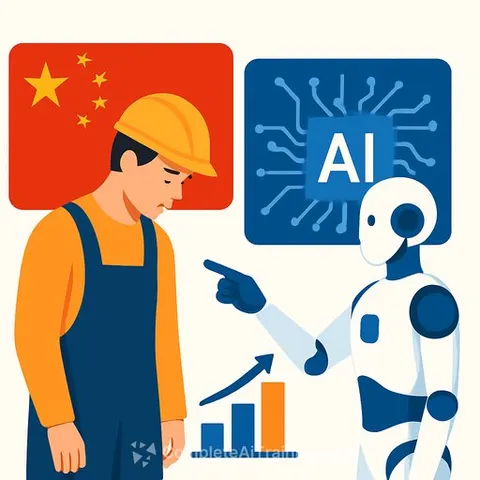
In Wuhan, China, taxi drivers began protesting two years ago against a growing fleet of driverless robotaxis. Petitions were filed, social media hashtags trended, and the outcry was noisy enough to force the Chinese Communist Party's hand. The protests were censored online, but behind the scenes they set off a larger policy rethink: how to prevent artificial intelligence from displacing human workers on a massive scale - and the political instability that could follow.
China is embedding AI into every industry. A recent example came from the lab Z.ai, which unveiled GLM-5.2, a model nearly as good as Anthropic's latest but running at less than one-tenth the cost. Yet the race to build the most powerful model is not the only benchmark that matters. Managing the human consequences of automation may prove just as decisive.
Robotaxis become a flashpoint
Wuhan has become the world's largest open-air laboratory for driverless cars. As the autonomous fleet expanded, traditional taxi drivers saw their livelihoods threatened. Complaints spilled onto social media, and local petitions were filed. The party responded by suppressing the protests online, but the episode also exposed a vulnerability that leadership could not ignore.
The party's recalibration
The Communist Party's deepest fear is social unrest, and mass AI-driven unemployment could destabilize the country. So while state-backed labs race against U.S. rivals, Chinese policymakers are also designing what some call "AI Marxism" - a blend of technological ambition and state-led efforts to protect workers. Details remain opaque, but the goal is clear: embed AI without triggering a backlash from displaced labor. The party's swift censorship was followed by an internal push to address the underlying problem, with planning bodies studying how to manage the transition in a way that preserves social stability. Workforce planning of this kind is increasingly addressed by training such as AI for Government Courses.
A different benchmark for AI leadership
The U.S.-China AI rivalry often focuses on metrics like benchmark scores and cost efficiency. GLM-5.2's low running cost is the latest data point. But the country that solves the employment question may claim a longer-term edge. China's central planning apparatus is grappling with issues that automated industries everywhere will face: retraining programs, universal basic income experiments, and new labor protections. As autonomous systems advance, professionals involved in deployment can benefit from AI Agents & Automation Training to understand their operational impact and workforce implications.
Why this matters for government and IT professionals
China's experiment with managing AI-driven job loss is a preview of tensions that will emerge in every major economy. Government officials must develop policies that encourage innovation while protecting workers from abrupt displacement. For IT and development professionals, the shift means automation tools will change job requirements, creating demand for skills in orchestrating and securing AI systems rather than performing routine tasks. The countries and companies that plan for this transition now will be better positioned to avoid the unrest that Wuhan's taxi drivers foreshadowed.