
AI news ·
China's AI health apps reach 10 million daily consultations as rural users turn to digital doctors
Ant Health's AQ platform now handles over 10 million daily consultations, connecting rural Chinese patients with AI health guidance and 300,000 physicians. More than half its users live in areas where specialist care requires hours of travel.
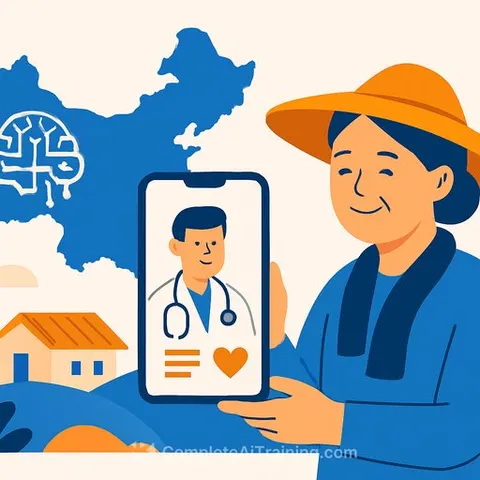
China's AI Healthcare Platform Reaches 10 Million Daily Consultations
Qian Zhifang, a 65-year-old factory worker in rural Hubei province, checked her blood pressure on a smartwatch and received medical guidance within seconds-not from a hospital hours away in Wuhan, but from an artificial intelligence system on her phone. She now consults the app regularly for health questions and can connect with a real doctor online when needed.
Qian represents a shift in how China delivers medical care. Ant Health's AQ platform, launched in mid-2025, has grown to more than 10 million combined daily consultations, with monthly active users triple that number. The system combines AI-generated health guidance with access to physicians, addressing a structural problem: while major cities have world-class hospitals, patients in smaller towns and rural areas often travel long distances for specialist care.
How the Platform Works
AQ draws on clinical guidelines, peer-reviewed journals, and partnerships with more than 5,000 hospitals and 300,000 physicians. More than 55 percent of users live in third-tier cities or smaller communities, where access to specialists is limited.
The platform includes "AI doctor avatars" modeled on the knowledge of more than 1,000 physicians. Patients ask routine questions to these virtual doctors, while complex cases are redirected to human specialists. The avatars allow doctors to focus on difficult cases while giving patients in remote areas access to medical expertise they might otherwise never reach.
Data privacy is built into the system. Users control whether their information-test results, prescriptions, photos-is uploaded and used. The platform automatically blurs sensitive information and encrypts data end-to-end. Patient health data is not used to train the underlying AI models, according to Shen Yunfang, head of communications at Ant Health.
Research Pushing Further
Beyond commercial platforms, researchers at Tsinghua University are developing "Agent Hospital," an experimental system where AI doctors diagnose and treat simulated patients in a fully virtual environment. Multiple AI agents collaborate, mimicking real hospital workflows.
Liu Yang, executive dean of the Institute for AI Industry Research at Tsinghua University, said the system allows AI to learn medicine the way young doctors do-through repeated exposure to cases, decision-making, and feedback. "In a virtual setting, they can accumulate experience at a scale and speed that would be impossible in the real world," Liu said.
Real-World Adoption and Resistance
Some physicians are already using these tools. Zhang Ling, a cardiologist at China-Japan Friendship Hospital, uses Ant Health's desktop platform to manage online consultations. The AI assistant organizes patient information before consultations begin and identifies potential warning signs, making triage more efficient in hospitals where doctors see dozens of patients daily.
But adoption has faced resistance within hospitals. Some administrators and clinicians remain cautious about integrating large AI models into clinical workflows, citing concerns over reliability and professional risk. "Medicine is not just pattern recognition, but involves judgment, responsibility, and uncertainty," one unnamed hospital administrator said. "If an AI system produces an incorrect recommendation, even rarely, the consequences in a clinical setting can be serious."
Data governance presents another barrier. Some hospitals are reluctant to share internal data with external platforms, fearing loss of control or unintended exposure. Developers say such concerns are understandable but often misplaced. Most platforms operate under strict data isolation protocols, with patient information encrypted and stored in controlled environments.
Gaps Remain
Mo Kai, a Beijing-based health policy expert, warned that overreliance on automated systems could introduce new risks, particularly in complex or ambiguous cases. "Medicine is full of uncertainty. When cases fall outside standard patterns, human judgment becomes critical, and that's where current AI systems still struggle," Mo said.
Accessibility also remains uneven. While digital tools can extend care to underserved populations, they may be less effective for elderly users or those unfamiliar with smartphones. Ant Health launched a senior-friendly interface with dialect support in February to address this gap.
For patients like Qian, the technology is already changing daily healthcare. She now monitors her blood pressure regularly and consults the app whenever questions arise. "It makes me feel less alone dealing with my health," she said.
Learn more about AI for Healthcare and how Generative AI and LLM systems are being applied in clinical settings.