AI is set to reshape China's high-speed rail operations: what ops leaders need to know
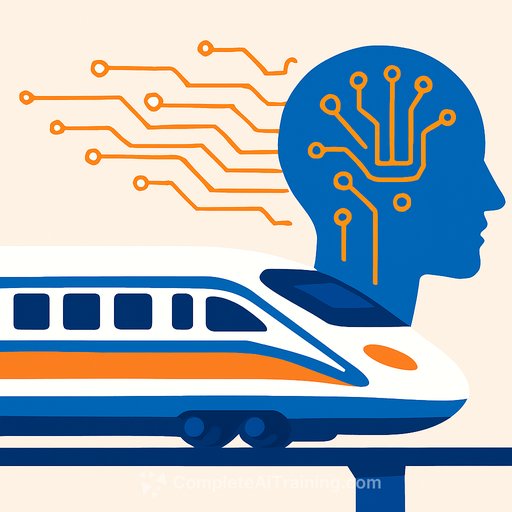
Artificial intelligence is moving from pilot to practice across China's high-speed rail system. Zhao Hongwei, chief researcher at the China Academy of Railway Sciences and a member of the 14th National Committee of the CPPCC, says AI is being applied to operations, maintenance, and safety at scale - with a formal "AI Plus Railways" action plan now guiding deployments.
"China's railway system is shifting from rapid expansion to higher-quality development, and technologies such as artificial intelligence will be an important driver of that transition," Zhao said. For operations teams, this means better visibility, faster decisions, and tighter control loops across an exceptionally complex network.
What's new: the "AI Plus Railways" push
Railway authorities have issued a program to integrate AI across transport and production scenarios, including a railway-specific large AI model that's now in pilot use. Early wins are coming from computer vision, line-side monitoring, intelligent train control, and data-driven scheduling.
- Computer vision for rolling stock health: high-speed cameras capture component images; models flag wear, cracks, and alignment issues for rapid response. "AI can help detect abnormalities earlier and allow engineers to respond more quickly," Zhao said.
- Line-side hazard detection: models identify obstacles and animals entering corridors, enabling proactive mitigation before operations are affected.
- Train control and network management: China has tested automatic train operation at 350 km/h. Next-gen systems will assist drivers with fault identification, energy-efficient driving, and decision support.
- Scheduling optimization: algorithms rebalance rolling stock and crews across peak flows to improve throughput and on-time performance.
- Predictive maintenance: sensors across trains and infrastructure stream data to models that forecast failures and optimize maintenance windows.
Scale that demands AI
China operates the world's largest high-speed rail network: over 50,000 km of high-speed lines within a 165,000 km national network by the end of 2025. About more than 4,000 high-speed trains run nearly 10,000 services each day, carrying 4.26 billion passenger trips in 2025.
At this scale, even small gains compound fast - a single percentage point improvement in on-time departures, energy use, or turnaround time creates system-wide impact.
Next-gen trains and infrastructure
Prototype testing of the CR450 high-speed train continued in 2025, with technical performance at world-leading levels, according to Zhao. Research on key infrastructure for 400 km/h railways advanced, and a new 200 km/h power-concentrated train entered operational testing.
For 2026, priorities include completing operational testing and finalizing the CR450 design, while expanding trials of 400 km/h infrastructure technologies and deepening research on automatic train operation.
Deployment patterns that work in operations
- Predictive maintenance loop: sensor and vision data → anomaly detection → health index and remaining life → targeted work orders → feedback into models.
- Dispatch and timetable optimization: demand forecasts paired with rolling stock availability, crew rules, and maintenance windows to reduce conflicts and dwell variance.
- Energy-efficient driving: AI co-pilots suggest speed profiles, braking points, and coasting zones based on gradient, load, and timetable slack.
- Incident detection and response: real-time alerts for trespass, weather, or asset faults with playbooks that auto-trigger work teams and reroutes.
- Digital twins and simulation: shadow-mode testing of ATO and scheduling models before live deployment to cut risk.
Metrics to manage
- Mean time between service-affecting failures (fleet and infrastructure).
- False positive/negative rates for defect and hazard detection.
- On-time performance, headway stability, and dwell time variance.
- Energy consumption per train-km and regenerative braking capture.
- Maintenance yield: percent of predicted defects confirmed and addressed on first visit.
Risk controls and safeguards
- Safety by design: fail-safe defaults, graceful degradation, and clear human-in-the-loop thresholds for ATO and decision support.
- Data quality: curated, labeled datasets across seasons, geographies, and rolling stock variants to avoid blind spots.
- Model governance: versioning, audit trails, bias checks, and periodic revalidation under operating rulebooks.
- Cybersecurity: segmented networks, signed models, and continuous monitoring for data poisoning and spoofing.
- Change management: role-based training, simulator time for drivers and dispatchers, and clear SOP updates.
12-24 month playbook for operations leaders
- Pick two high-signal pilots: vision-based rolling stock inspection and line-side intrusion detection. Define success with measurable KPIs.
- Stand up a unified data layer: event, video, and sensor streams with retention policies and labeling workflows.
- Run shadow mode for ATO decision support on selected corridors before live activation.
- Integrate with TMS/CTCS and maintenance management systems so insights trigger work orders and timetable adjustments automatically.
- Align early with regulators and safety committees; document hazard analyses and test evidence.
- Upskill crews and controllers with scenario-based drills and simulator feedback.
AI in rail is moving from promise to operations reality. As Zhao notes, the opportunity is to find risks earlier, act faster, and operate more efficiently - at the scale this network demands.
For a quick primer on practical playbooks and tools, see AI for Operations. If you lead a transport team and need a structured path to implementation, explore the AI Learning Path for Transportation Managers.
For additional context on ATO concepts and levels, the International Union of Railways provides a helpful overview here: UIC: Automatic Train Operation.
Your membership also unlocks: