China's AI hiring sprint: what HR needs to act on this spring
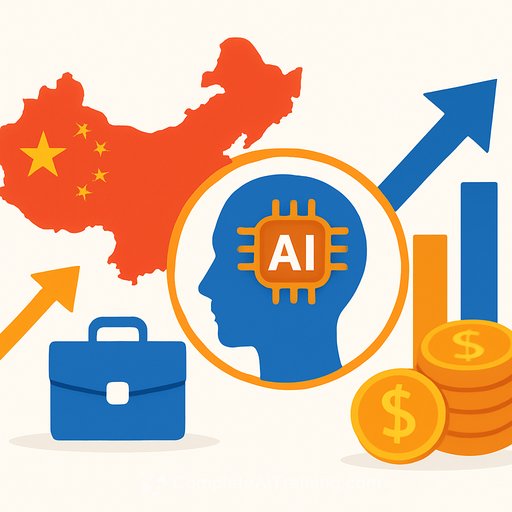
China's AI job market just flipped into high gear. Job postings are up 12x, while average monthly pay sits at 60,738 yuan ($8,832) - about 26 percent higher than other new emerging industries.
AI roles jumped from 2.29 percent of new-economy jobs in early 2025 to 26.23 percent in 2026. The short version: demand is surging, and the hiring window is open - for those who move first.
Signals HR should track
- Demand surge: AI postings up 12-fold; sector-wide job growth at 12.77 percent in Jan-Feb.
- Comp lead: AI monthly salaries average 60,738 yuan, about 26 percent above other emerging fields.
- Talent scarcity: Supply-to-demand ratio for AI is 0.97 vs 1.79 across the new economy. Another official figure pegs it at roughly 1:3.5 (supply:demand).
- Market focus: 2026 kicks off the 15th Five-Year Plan (2026-2030), with "new quality productive forces" as a key policy theme - translating into firm-level hiring budgets and headcount approvals.
Who's hiring - and for what
Ant Group's spring campus drive puts more than 70 percent of roles in AI - spanning research, applications, and infrastructure. Priority areas include large-language model algorithms, embodied intelligence, and AI security.
Tencent and ByteDance are also scaling AI recruitment. As use cases prove commercial value - think platforms like OpenClaw enabling new ways to monetize computing power - the hiring race shifts from wait-and-see to land-and-build.
What this means for HR leaders
- Compensation: Set AI salary bands above other emerging roles and tie them to clear skill tiers. Add sign-on, equity, and fast review cycles to win speed-sensitive candidates.
- Speed-to-offer: Target a 7-10 day hiring loop. Pre-book interview panels, assign a decision owner, and empower same-day verbal offers after final rounds.
- Role design that sells: Promise real model ownership, access to compute, high-quality data, and mentorship. Offer publication support and open-source time where it helps brand and hiring.
- Skills-based hiring: Hire for capabilities, not titles. Prioritize LLM systems, data engineering, MLOps, AI infra, AI security, and embodied intelligence. Use work samples, repos, and short technical tasks.
- Pipeline building (campus-first): Run targeted university events, code challenges, and micro-internships. Build relationships with labs aligned to your stack.
- Upskill internally: Transition strong software, data, and infra talent into AI roles. Budget time-boxed sprints with clear 30/60/90-day outcomes and a dedicated mentor.
- Leverage public training: The government plans subsidized skills training for 10+ million participants this year. Partner with local training centers and apply for subsidies to offset costs.
- Employer brand: Communicate your AI roadmap, toolchain, and governance standards. Candidates want clarity on impact, tech depth, and learning velocity.
- Workforce planning: With AI at 26.23 percent of new-economy roles and supply below demand, lock forecasts now. Phase headcount across quarters to avoid later premium hires.
Roles in high demand
- LLM Research/Applied Scientist (pretraining, fine-tuning, evaluation)
- LLM Application Engineer / Agent Engineer
- AI Security Engineer (model, data, and application security)
- Embodied Intelligence / Robotics Engineer
- Data Platform and MLOps Engineer
- GPU/Distributed Systems Engineer (training and inference)
Practical next steps this week
- Publish salary-backed AI job ads with crystal-clear project outcomes and tech stacks.
- Stand up a fast hiring loop: structured screens, technical task, final panel, decision meeting same day.
- Launch a campus push: 45-minute virtual info session, challenge, and next-day interviews.
- Offer compute and data access in onboarding plans; share 30/60/90-day deliverables in interviews.
- Run a two-week internal referral sprint with tiered bonuses for AI-critical roles.
- Map talent sources by skill (LLM, MLOps, AI infra, security) and assign an owner per channel.
- Apply for local training subsidies and set up a vendor shortlist for targeted upskilling.
Resources for HR teams
- AI for Human Resources - frameworks and tools to upgrade recruiting, talent management, and workforce planning for AI roles.
- AI Learning Path for Recruitment Coordinators - practical steps to scale AI-specific sourcing, screening, and hiring operations.
The takeaway: AI talent is scarce, salaries are higher, and the hiring clock is moving fast. Build a faster process, design roles top candidates want, and use every lever - campus, internal upskilling, and subsidies - to win the cycle.
Your membership also unlocks: