
AI news ·
Chinese AI summer camps charge thousands of yuan but lack qualified instructors
Chinese parents pay up to $2,000 for AI summer camps. Many programs rely on unqualified tutors and offer little more than facility tours.
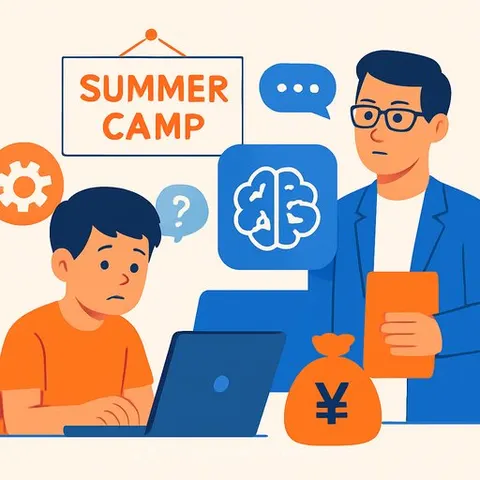
Chinese summer camps that promise to turn children into AI-savvy "venture capitalists" in under a week are multiplying, with some charging nearly 13,000 yuan ($2,000). The surge comes as parents, anxious about their children falling behind in the AI era, pour money into programs that often deliver little more than unqualified instructors and a photo op at a tech company, according to a China Newsweek report.
The camps sit at the intersection of a national education push and a fast-growing market. China's education plan, released in June, integrates AI across all school levels. The Ministry of Education has set a target to make AI education "basically universal" in primary and secondary schools by 2030. A Changjiang Securities report projects the country's AI education market will reach 160 billion yuan by 2027 and nearly 180 billion yuan by 2030.
What the camps offer - and what they cost
One Beijing-based study tour company advertises a six-day program that teaches children to "launch an AI startup." The live-in course, priced at 13,000 yuan, covers AI basics, business skills, and financial thinking. A staff member told China Newsweek, "Many college students can't create a business model template, yet our campers can present one on stage after just six days."
Multi-day AI study camps in Beijing and Shanghai typically start around 6,000 yuan. In Hong Kong, equivalent courses usually exceed 10,000 yuan, and overseas programs can reach 30,000 yuan. Official rules require study tour operators to hold business registration, a travel permit, and an educational service certification, but many AI camp organizers are media firms or one-person companies, China Newsweek found.
Instructors and industry shortcuts
A shortage of qualified AI teachers means many programs rely on graduate students with minimal training or basic programming tutors. One edtech recruiter told domestic media that her company interviewed music and sports majors for an AI teaching role and ultimately hired a flight attendant. "A few days of training is standard," she said.
A study tour industry veteran with a decade of experience said STEM camps have overtaken traditional outdoor programs. Her own children's AI camp at Harbin Institute of Technology sold out after advertising exclusive access to a chip lab. But she noted that many companies double their prices while only offering facility visits, not actual coursework. "As long as kids snap a photo at HIT, the trip is deemed 'meaningful' (by parents)," she said.
How parents are navigating the hype
Dong Ling, a Shanghai mother of a 5-year-old, sees AI as a tool rather than a race. "AI amplifies (children's) existing strengths," she said. "For their generation, AI is their native environment." She believes parents should focus on weaving AI into daily learning instead of chasing expensive camps. "We are entering an era of human-AI collaboration. Instead of chasing hype, parents should focus on teaching kids how to use these tools responsibly and creatively in their daily lives."
Song, a Guangzhou parent of two, plans to enroll her children in AI camps once they reach middle school. She prioritizes interaction, hands-on work, and small classes. "I hope my kids make diverse friends, learn about others, see their own differences, and gain real knowledge through firsthand experiences," she said. Yet she remains calm about AI's rapid rise. "Some human qualities can't be replaced."
An 11-year-old camper surnamed Xu spent five days at an AI camp at Alibaba's Hangzhou headquarters. She toured the campus, joined coding sessions, and used Alibaba's large language model Qwen to generate a business plan template for a simulated online store. "I learned so much that isn't in our textbooks," Xu said.
Why this matters for educators
The AI camp boom reveals a gap that schools and teachers are being asked to fill. With national policy pushing AI into every grade level, educators face pressure to deliver quality instruction while parents spend thousands on unregulated alternatives. For teachers building these skills, structured resources like the AI Learning Path for Teachers can help integrate AI into classrooms without relying on overhyped, short-term programs. The broader shift toward AI for Education demands that schools focus on consistent standards - teaching children to use AI as a native language, not a gimmick - and that educators guide students and parents toward meaningful, long-term AI literacy rather than quick-fix promises.