The Jobs AI Is Taking First Aren't The Ones You Might Expect: An HR Playbook
AI isn't just trimming headcount in tech. It's reshaping job families across the board - with clerical and support roles feeling the first wave. The World Economic Forum projects major churn, with millions of roles created and millions more made redundant as digital access and AI reshape work. Their latest report highlights how broad this shift is becoming.
See the WEF's Future of Jobs Report for the high-level data. But here's what matters for HR: who's at risk, where demand is spiking, and how to move now so your org isn't reacting from behind.
Who's getting hit first
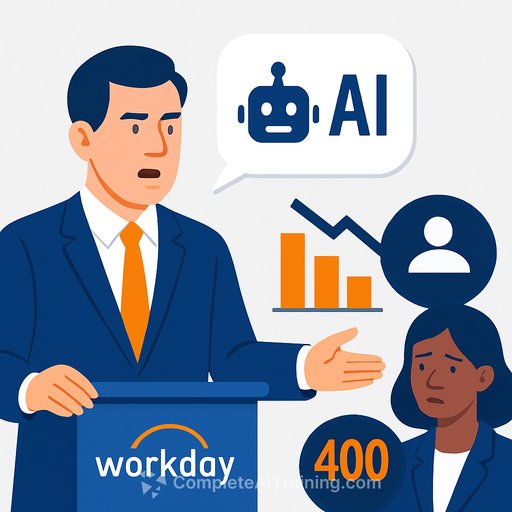
The biggest early losses are in routine-heavy office roles: clerks, secretaries, and administrative assistants. Large tech firms have also cut non-technical roles, while experimenting with AI agents for internal support - even in HR workflows.
That doesn't mean white-collar jobs vanish. It means the task mix changes. As Walmart's CEO Doug McMillon put it, "Every job we've got is going to change in some way." HR should plan for role redesign, not just reductions.
Where demand is growing
Even as some support roles shrink, demand is rising for work with higher judgment, systems thinking, and human-in-the-loop accountability. Think prompt engineering, automation operations, data quality, and workflow design. These roles rely more on critical thinking than repetition.
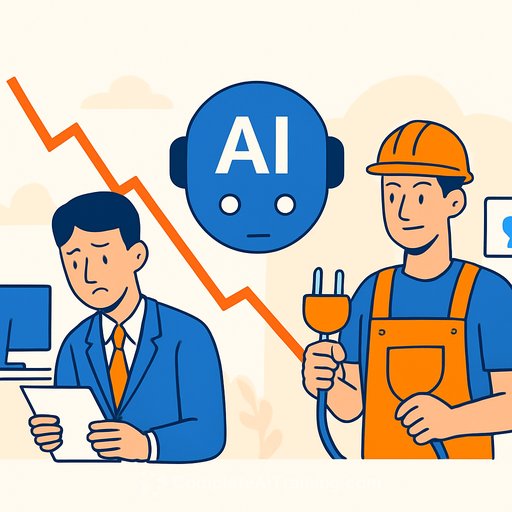
Outside the office, AI's footprint is physical. Data center build-outs are driving demand for electricians, HVAC specialists, plumbers, and carpenters. If your company is scaling AI infrastructure, skilled trades hiring becomes a strategic constraint - and a competitive edge.
AI is leaving the office and hitting the floor
Robotics is getting smarter: fruit picking, coffee making, store greeting - plus safer deployment in hazardous environments. On factory floors, expect robots to take on more materials movement and repetitive station work as AI models improve reliability.
The impact won't be even. Studies often find lower-education, routine tasks are automated first. HR needs a plan for redeployment, reskilling, and timing - not just a policy update and a memo.
What HR should do this quarter
- Run a task-level audit: Map roles into tasks. Flag repetitive, rules-based tasks (prime for automation) versus judgment-heavy tasks (prime for augmentation).
- Redesign job architectures: Split "operator" from "owner." Create titles for automation owners, prompt engineers, AI QA, and data stewards. Update leveling and compensation bands.
- Start skills-based hiring: Rework job posts to focus on problem framing, data literacy, and system oversight instead of years of general experience.
- Build a redeployment pipeline: Identify at-risk cohorts (clerical, support) and define landing zones: operations coordination, automation support, compliance, data ops.
- Stand up AI governance: Define who approves tools, who monitors outputs, and what "human review" actually means. Document failure modes and escalation paths.
- Secure trades capacity: If data center or automation projects are planned, line up electricians and other critical trades early. Treat these hires like priority tech roles.
Signals to watch in your org
- Ticket and workflow data: Rising backlogs in repetitive tasks often precede automation pushes. Get ahead of it with redesign and training.
- Shadow AI usage: Teams quietly testing chatbots and RPA are telling you where to standardize and secure.
- Vendor roadmaps: Your HRIS, ATS, CRM, and ERP providers are shipping AI features that can compress work. Plan change management before features go live.
- Facilities and IT plans: New data center spend or robotics pilots signal near-term shifts in hiring and training for operations and safety.
Role transitions HR can enable
- Admin/clerical to automation support: Teach prompt patterns, exception handling, and documentation. Emphasize process awareness and quality control.
- Recruiters to talent intelligence: Rescope into market mapping, skills taxonomies, AI-assisted sourcing, and scenario hiring plans.
- HR generalists to AI governance coordinators: Policy rollout, model risk documentation, audit trails, and vendor compliance management.
- Operations staff to robotics floor leads: Safety protocols, uptime metrics, changeovers, and human-robot handoffs.
30/60/90 for practical momentum
- 30 days: Complete a task inventory for four functions (HR, Finance, Customer Support, Operations). Pilot one AI assist per function with clear guardrails.
- 60 days: Publish an internal skills framework for AI-era roles. Update two job families with new titles and competencies. Launch redeployment paths for at-risk roles.
- 90 days: Bake AI checks into performance and QA. Stand up an internal "automation council" to prioritize use cases, track outcomes, and prevent tool sprawl.
Metrics that keep you honest
- Percent of tasks automated per role (with a human review step defined)
- Time-to-productivity for re-skilled employees moving into AI-adjacent roles
- Quality drift (error rates before/after automation) and escalation rates
- Vendor count tied to AI features (tool sprawl is a silent cost center)
Hiring notes for the "new" roles
- Prompt engineers: Look for structured thinking, domain context, and quick iteration habits more than fancy titles.
- Automation specialists: Process mapping, exception handling, and change management trump pure coding chops.
- Data stewards / AI QA: Pattern spotting, sampling discipline, and the patience to document edge cases.
- Trades for infrastructure: Prioritize certifications, safety record, and experience with high-availability facilities.
Upskilling resources
If you're formalizing learning paths, point teams to focused tracks that build practical skills fast. For structured options:
- AI courses by job role for targeted, role-based learning
- Prompt engineering resources to improve day-to-day output quality
Bottom line for HR
Don't frame this as "jobs vs. AI." Frame it as tasks moving around - and your job is to redesign work, redeploy people, and hire for judgment. The first movers aren't waiting on perfect certainty.
Do the task map. Update the job architecture. Build the training path. Then turn on the pilots and measure what changes. That's how you protect people and performance at the same time.
Your membership also unlocks: