Mind the AI value gap: Operational intelligence is defining the agentic workforce
AI agents demo well. Running them at scale with real tickets, telemetry and controls is where many teams stall. That gap between prototype and measurable outcomes is the AI value gap. Operations leaders are now closing it with operational intelligence - a fabric that ties agents, data, and runbooks into governed action.
What the AI value gap looks like in operations
Teams spin up pilots that work in isolation, but fail in production because they lack data quality, context and guardrails. The result: stalled rollouts, risk concerns and unclear ROI. The fix isn't "more models." It's a system that turns signals into actions you can trust, measure and audit.
Operational intelligence: the connective fabric
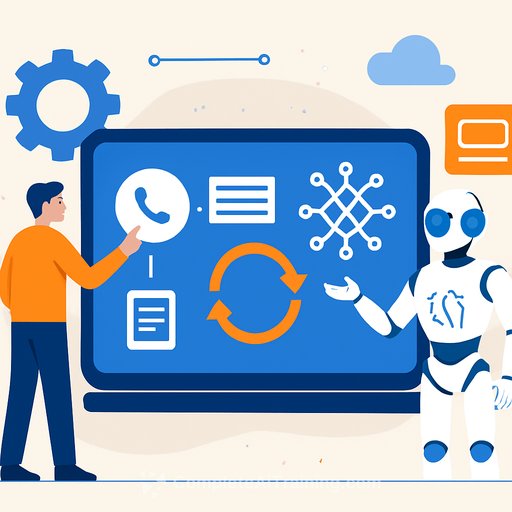
Think beyond dashboards. You need a fabric that unifies data, models and runbooks so agents can ingest alerts, tickets and logs, act with context, then record what they did, why, and what happened next. This creates a loop you can improve week over week.
As described in a recent conversation with Fabrix.ai's Shailesh Manjrekar and theCUBE Research's Bob Laliberte, the platform matters more than any single model. Large language models are just one piece. Enterprise outcomes come from the stack around them - policy, observability, approvals, and context delivery.
Guardrails first, then scale
Agentic AI needs discipline. Governance, observability and change control must be built in from day one. Actions should be fully auditable, config-driven, and reversible. Treat the LLM as a means to an end, not the system of record.
If you're evaluating platforms, ask about key foundations: data lineage, role-based access, policy enforcement, incident playbooks, and a dynamic context layer (for example, a Model Context Protocol server) that feeds the right data to the right agent at the right time.
What an agentic operational intelligence platform includes
- Unified data and telemetry: normalized events, tickets, logs, metrics and topology with lineage.
- Context routing: a governed way to deliver scoped, timely context to each agent.
- Runbook automation: versioned playbooks (detect, diagnose, act, verify) mapped to SLOs.
- Guardrails: role-based actions, approval workflows, blast-radius limits and rollbacks.
- Observability of agents: step-level traces, reasons for decisions and outcome tracking.
- Change control: policy-backed promotion from dev → staging → prod with audit trails.
- Cost and risk controls: rate limits, execution budgets and data minimization by default.
From pilots to outcomes: a simple rollout plan
- Weeks 0-2: Pick two noisy, high-volume incidents (e.g., disk pressure, service restarts). Document desired outcomes, SLO impact and rollback rules.
- Weeks 3-6: Build closed-loop runbooks. Start with "recommend-only," then move to auto-remediation with approvals. Track mean time to resolve, change fail rate and ticket deflection.
- Weeks 7-12: Expand to three more use cases. Introduce guardrail policies for time windows, environments and cost ceilings. Add business impact metrics.
The metrics that matter
- Speed: MTTA/MTTR reduction, time-to-rollback, time-to-root-cause.
- Cost: ticket deflection, workload-to-operator ratio, compute spend per action.
- Risk: change fail rate, unauthorized action attempts blocked, data access violations prevented.
- Quality: alert fatigue cut, re-opened incidents, accuracy of agent recommendations.
Practical guardrails for accountable agents
- Approval tiers: recommend → supervised execute → auto-execute for low-risk playbooks.
- Scope limits: enforce environment, service and time-of-day boundaries.
- Data controls: least-privilege access, redaction and context windows tuned per action.
- Auditability: immutable logs of prompts, context, actions, diffs and outcomes.
- Rollback first: every action pairs with a tested reversal path and blast-radius cap.
Why this matters now
Operations teams don't need more dashboards. They need accountable action. The shift is from buying more tools to increasing workforce capacity with agents that are observable, governable and tied to SLOs. That is how the AI value gap closes - with measurable improvements in cost, risk and speed.
Context from theCUBE event
These insights were discussed during "Agentic AI Unleashed: The Future of Digital & IT Operations," an exclusive broadcast on theCUBE, SiliconANGLE Media's livestreaming studio. Fabrix.ai's Shailesh Manjrekar and Bob Laliberte of theCUBE Research outlined what an enterprise-ready agentic platform looks like and how guardrails translate to real outcomes.
Further reading
Skills and training
If you're building an internal program for Ops teams, a curated path can help align skills to roles and use cases. See practical options by job function here: AI courses by job.
Disclosure: TheCUBE is a paid media partner for the "Agentic AI Unleashed: The Future of Digital & IT Operations" event. Fabrix.ai, the sponsor of theCUBE's event coverage, and other sponsors do not have editorial control over content on theCUBE or SiliconANGLE.
Your membership also unlocks: