
AI news ·
Cloudbeds CEO warns hotel AI contracts signed in 2026 will be obsolete by 2029
Hotel CEOs signing AI contracts now risk locking into systems that will be obsolete by 2029. The core issue: most platforms pitched today can answer questions but can't reliably take action-repricing rooms, issuing refunds, moving reservations.
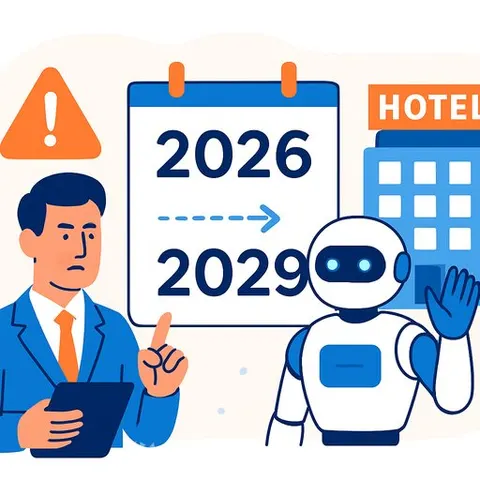
Hotel CEOs Are Committing to AI Architecture That Will Be Obsolete by 2029
Most hotel operators signing AI vendor contracts this year are betting on the wrong technology. Within three years, the systems they're deploying will function like fax machines - expensive relics blocking the path to what actually works.
The distinction comes down to how AI makes decisions. Probabilistic AI answers questions and produces impressive demos. Deterministic AI takes action with certainty: repricing a room at 2 a.m., issuing a refund, moving a reservation. One looks good in a pitch meeting. The other runs a hotel.
The Architecture Problem
When probabilistic AI fails, you get a wrong answer. When deterministic AI breaks, you get a chargeback or a bad review. The stakes are different. The architecture required is different. The vendor profile required is different.
Hotel CEOs evaluating AI platforms need to understand this distinction before signing multi-year contracts. Most of what's being pitched right now operates on probabilistic architecture - structurally unsuited to running operations at scale. The AI that actually accelerates a hotel business takes action with certainty, not probability.
This creates a procurement problem with real consequences. Operators who commit to probabilistic-based platforms on the strength of capability demos are locking themselves into obsolete architecture for years.
The Buyer-Side Problem Most Hotels Aren't Planning For
Hotels are building AI to manage their side of transactions - pricing, inventory, upsells. Guests are about to bring AI to the other side: price comparison tools, review aggregation, value-extraction flagging, counter-offer generation.
Both sides negotiating in real time is the next major disruption in travel. Most travel companies are building only for the operator side. The next two years will show whether their architectures can hold against AI optimized specifically to extract value the operator's AI is trying to capture.
Where to Draw the Line on Human Involvement
Stop asking how much human oversight you need in the AI loop. Start asking what you're grading your humans on. The line you grade them against is the line that separates automation from irreplaceable judgment.
Below that line, automate. Above it, your people are irreplaceable. This framework determines which decisions your AI should own and which ones require human judgment.
What Hotel Leaders Should Demand From Vendors
When evaluating any AI platform, CEOs need specifics. What questions should you ask in vendor diligence? What does the data layer look like architecturally? How do you distinguish a real deterministic platform from one that markets the language but ships probabilistic infrastructure underneath?
Vendors should be able to explain their architecture in terms of how it handles action-taking at scale, not just how well it answers questions. If they can't, you're looking at probabilistic technology dressed up as deterministic.
Learn more about AI Agents & Automation and how to evaluate these systems for your operation. For hospitality-specific AI implementation, explore AI for Hospitality & Events.