
AI news ·
Colleges weigh top-down versus bottom-up approaches to AI adoption as governance and faculty training challenges persist
Colleges are taking two paths to AI adoption: executive mandates or faculty-led experimentation. Most institutions say both approaches are needed for implementation to actually work.
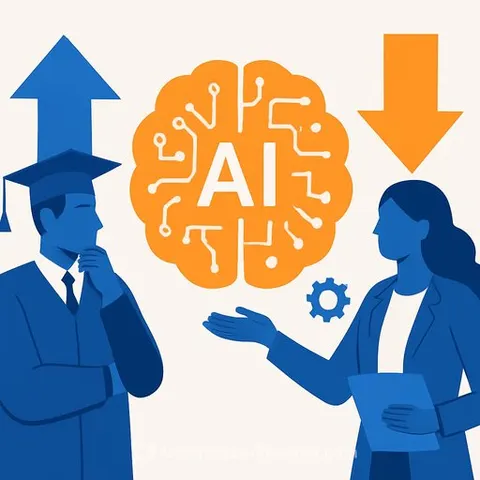
Colleges Split on AI Strategy: Top-Down Leadership vs. Faculty-Led Experimentation
Colleges are adopting artificial intelligence through two distinct paths-executive mandate or grassroots faculty exploration-but institutions say both approaches will ultimately be necessary.
The American Association of Colleges and Universities hosted a webinar series this week featuring AI leaders from institutions of varying sizes. Their consensus: successful implementation requires blending top-down strategy with bottom-up faculty participation, though which approach works best depends on institutional culture and governance.
Executive-Led Implementation
The University of North Carolina at Charlotte and Albizu University in Puerto Rico began with leadership signaling AI as a strategic priority.
At UNC Charlotte, the chancellor and provost issued a memo in 2022 framing AI as "acceptable" and necessary for workforce preparation. This signal launched a formal AI task force with nearly 400 campus participants, followed by a standing leadership body to implement recommendations. The university has since created two new undergraduate and graduate degrees in AI and multiple minors.
Kiran Budhani, director of teaching and learning innovation at UNC Charlotte, said: "Moving your campus forward over multiple years really requires thoughtful and intentional guidance, leadership and support from your leaders, as well as from your faculty, as well as from the students."
Albizu University's board of trustees took a similar approach, issuing an initial AI policy and convening a committee. Chief Academic Officer Berta Rios said the university then gathered broader input through faculty forums and applied for funding to support 50 AI implementation projects. While the funding didn't materialize, the applications helped the university develop a concrete plan and understand budget requirements.
Mid-State Technical College in Wisconsin aligned AI adoption with workforce needs. The college established AI as a strategic priority, created clear institutional policies, and embedded AI as an employability skill across programs-from cosmetology to diesel mechanics to general education.
Desiah Melby, an instructor and chair of the college's AI in teaching and learning group, said the college provided syllabus language and grading rubrics to signal which AI uses were allowed in each course.
Faculty-Led Exploration
Berry College and Gettysburg College took a different route, starting with informal faculty conversations before institutional guidance existed.
At Berry, a history faculty member began convening peer discussions about AI independently. From those conversations, the college defined four goals: develop training resources for faculty and staff, articulate student learning outcomes related to AI, support shared policies, and approach academic integrity through development rather than punishment.
Provost David Slade said implementation has been deliberately incremental. About one-third of faculty members have participated in discussions and studies so far, part of the college's broader faculty training goal.
Choosing Your Path
An institution's approach should reflect its goals and culture. Institutions relying on executive strategy gain coordinated direction and resource allocation. Those starting with faculty exploration build buy-in and allow time for careful planning.
Most institutions will need both. Early executive commitment provides the framework; faculty participation ensures the framework actually works in classrooms and programs.
For executives leading AI adoption, AI for Executives & Strategy resources address implementation approaches and institutional governance. AI for Education covers curriculum updates and faculty training in detail.