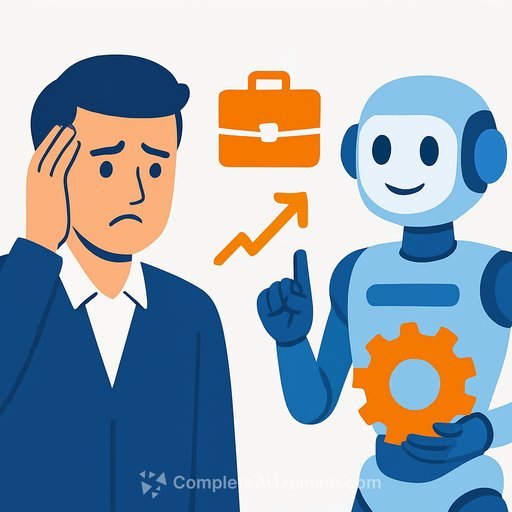
The key to companywide AI adoption: put managers in the driver's seat
Gartner's latest analysis is clear: if you want AI to stick across the business, empower managers. Close to half of managers reported experimenting with AI to improve their work, while only 26% of employees said the same.
Grassroots tinkering won't carry an enterprise. Managers sit closest to workflows, trust, and results. Equip them, and adoption follows.
Why managers, not casual experimentation
Managers control priorities, norms, and performance conversations. They can turn scattered tool tests into standard operating procedures.
But support is needed. In a July 2025 survey, only 14% of nearly 2,000 managers said they had no challenges driving effective AI use across their teams. Most struggled and want help.
Gartner HR Research highlights the path: align training to team needs, manage resistance, and make the business case up the chain.
What HR should provide right now
- Team-specific enablement: Build role-based workflows, micro-demos, and cheat sheets that match each team's real tasks.
- Change support: Prepare managers to handle emotional resistance - fear of job loss, quality concerns, and tool fatigue.
- Value storytelling: Coach managers to connect use cases to metrics execs care about: cycle time, error rate, cost per ticket, pipeline velocity, NPS.
AI is saving "small and fractured" time - for now
Today, AI often frees minutes, not hours. As tools improve, those minutes compound into material capacity. That time must be redeployed with intent, not left to chance.
Only 7% of organizations offer guidelines on what to do with time saved by AI. HR leaders often want special projects (55%), while just 28% of managers would prioritize the same. This gap wastes momentum.
A simple time-redeployment playbook
- Define buckets: 1) Core work quality (reduce errors, faster cycle time), 2) Customer value (more touches, better personalization), 3) Capability building (AI skills, data literacy), 4) Innovation sprints (process or product ideas).
- Set ratios: Example: 50% core quality, 25% customer value, 15% capability, 10% innovation - adjust by team maturity.
- Add guardrails: Minimum weekly investment per person (e.g., 45 minutes) and a monthly review to reallocate if results stall.
30-60-90 day manager plan
- First 30 days: Inventory top 10 tasks by time spent. Baseline KPIs (cycle time, error rate, backlog). Pick two AI use cases with clear win potential.
- Days 31-60: Pilot with 2-3 people per use case. Standardize prompts/templates. Track time saved and quality shifts weekly.
- Days 61-90: Roll out what worked. Retire what didn't. Turn winning prompts into SOPs. Publish a one-page results summary for execs.
Trust first: team guardrails that work
- Quality bar: Human review for external outputs until error rates drop below a defined threshold.
- Data rules: Clear policy on what can and cannot go into tools. No sensitive data without approved controls.
- Transparency: Share where AI assists the work. Credit the team, not the tool, for outcomes.
- No surprise moves: Communicate that pilots inform process, not headcount decisions. Revisit as impact becomes measurable.
Upward value: talk tracks for senior leaders
- Efficiency: "We cut average handling time by 18% on Tier-1 tickets, freeing 6 hours per rep per week."
- Quality: "Error rates dropped from 3.1% to 1.2% on reviewed outputs."
- Capacity redeployment: "We reinvested 60% of saved time into proactive customer outreach, lifting retention by 2 points."
- Risk control: "All outputs routed through policy checks; no PII entered into tools."
Handling resistance without losing momentum
- Listen, then label: Name the concern (accuracy, job risk, ethics). People move faster when they feel heard.
- De-risk: Start with low-stakes use cases where quality is easy to verify.
- Make wins visible: Weekly show-and-tell of prompts, workflows, and results from peers.
- Create choice: Offer two tool paths to the same outcome; let people opt into what fits their style.
Baseline metrics every manager should track
- Cycle time per key task
- Error/defect rate
- Throughput per person
- Customer satisfaction on AI-touched work
- Hours saved and how they were reinvested
Skill essentials for every team
- Prompting and review: Clear instructions, structured inputs, and tight feedback loops.
- Tool fluency: Knowing when to use chat, docs, sheets, slide assistants, and RAG/search features.
- Data judgment: Spotting hallucinations, verifying sources, and documenting decisions.
If you lead HR or manage managers
Set the system, then let managers run it. Provide targeted training, change support, and a scoreboard. Close the loop by showing how saved time turns into business impact.
For practical upskilling, see AI for Management. If you're in HR building enablement programs, the AI Learning Path for HR Managers can help you structure training and adoption frameworks.
Your membership also unlocks: