
AI news ·
Complete College America convenes nearly 200 higher education leaders to build AI governance frameworks
Nearly 200 college leaders from 30 institutions met in Chicago to build AI governance. The goal is using AI to raise completion rates and close equity gaps.
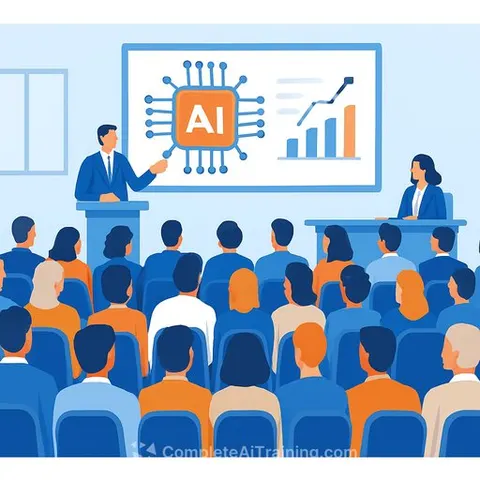
Nearly 200 college presidents, provosts, and student success leaders from more than 30 institutions met in Chicago this week for Complete College America's first AI and Student Success Summit. The three-day working session focused on building the governance structures, cross-institutional trust, and practical infrastructure that responsible AI adoption requires-with a specific emphasis on raising college completion rates and closing long-standing equity gaps.
Participating institutions spanned community colleges, HBCUs, Hispanic-Serving Institutions, and regional universities, including the University of Hawaii System, the City University of New York, the University of Massachusetts Lowell, Langston University, and the University of Louisville. Attendees worked in cross-functional teams-presidents alongside faculty and student success staff-to diagnose breakdowns in the student experience and develop concrete governance strategies to address them.
"AI is already reshaping the campus experience, oftentimes without governance, guardrails, or a clear answer to the most important questions-who benefits from it, and who gets left further behind?" said Dr. Yolanda Watson Spiva, president of Complete College America. "The leaders gathered here this week are not waiting for someone else to figure it out. They are doing the hard work of building the governance, the infrastructure and the cross-institutional trust that responsible AI adoption actually requires."
The organizational design problem
Complete College America has argued since 2022 that AI in higher education is less a technology problem than an organizational one. Norm Palmer, the organization's director of technology innovation, reinforced that point at the summit.
"AI in higher education is consistently framed as a technology adoption problem. It is not. It is an organizational design problem," Palmer said. "What separates the institutions closing completion gaps is not the sophistication of their tools-it is the sophistication of their people and systems."
Six competencies for institutional readiness
The summit's curriculum drew directly from CCA's flagship report, Generating College Completion, which lays out six competencies for institutional AI adoption: mission alignment, resource management, responsible use, data and tech infrastructure, talent development, and change management. This framework aligns with the growing body of work in AI for Education that emphasizes governance and equity over tool acquisition.
A companion publication released in July 2025, Building AI-Capable Institutions, offers case studies from the University of Louisiana System, UMass Lowell, and Arizona State University. Those examples show how institutions are using AI to improve student outcomes without massive budgets or wholesale organizational overhauls.
From research to student impact
CCA is translating its research into direct student support through the CCA AI Readiness Consortium, built in partnership with Riipen and funded by Axim Collaborative. The consortium helps community colleges embed AI competencies into academic programs via project-based learning that connects students with industry partners. The goal is to give students most vulnerable to AI-driven job disruption the skills to navigate it.
Earlier CCA research, including the report The AI Divide, catalogued more than 170 use cases for generative AI in higher education while arguing that equity must remain central to any adoption strategy.
Why this matters for education professionals
The summit signals a shift away from isolated AI experiments toward institution-wide governance. For education leaders, the takeaway is clear: waiting for top-down mandates or vendor solutions won't work. Building internal capacity-through cross-functional teams, clear accountability, and a focus on student outcomes-is what turns AI from a source of risk into a tool for closing completion gaps. More details on CCA's AI initiatives are available at Complete College America's website.