
AI news ·
Congress examines AI's role in higher education amid concerns over student learning and academic integrity
A House subcommittee heard Wednesday that AI is producing graduates who are over-reliant on the technology yet unprepared to use it professionally. Experts warned that if students outsource work to AI, college credentials lose meaning.
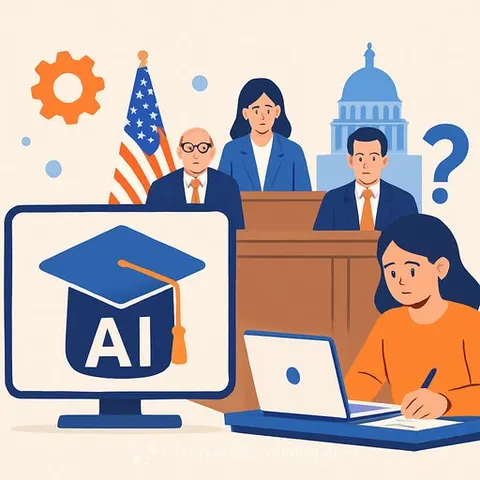
House committee examines AI's role in college education
Rep. Burgess Owens, who chairs the House Higher Education and Workforce Development Subcommittee, questioned education experts Wednesday about how artificial intelligence will affect college students' learning and job readiness.
The hearing surfaced a core tension: universities must teach students to use AI effectively while ensuring they still develop foundational skills like writing, critical thinking, and problem-solving. Owens said the challenges are "significant."
"If students can produce polished work without genuine learning, the value of a credential is diminished for employers, institutions and students," Owens said in his prepared remarks.
The credential problem
Owens highlighted specific concerns. Academic integrity systems designed for earlier eras are straining under pressure. Questions about bias, data privacy, and cybersecurity remain unresolved. Many educators worry that widespread AI use could weaken the very skills college is meant to build.
Jonathan Fozard, associate vice president and chief information officer at Florida State University, said AI is "quickly becoming a defining capability" in the workforce. Universities should teach students to use the technology responsibly, he said, but technology must serve instruction-not replace it.
"Higher education must prepare students not only to use AI, but to understand it, question it, improve it, secure it and apply it in ways that serve people and strengthen our nation," Fozard said.
The skills gap
Dave Duke, a product officer for McGraw-Hill, identified a growing problem: some students use AI constantly without supervision and have "learned to produce outputs without developing the capacity to evaluate them." Meanwhile, other schools restrict AI use entirely and discourage students from engaging with it.
The result is graduates "who are simultaneously over-reliant on AI and under-prepared to work with it professionally," Duke said. He rejected both unrestricted use and aggressive restriction as workable approaches.
Michael Horn, an adjunct professor at Harvard Graduate School of Education, suggested universities may need to redesign assignments themselves. "If AI can complete an assignment, perhaps the assignment itself is in need of change," Horn said.
He proposed replacing traditional tests or papers with oral exams or presentations to ensure students engage in the actual work of learning rather than outsourcing it.
Learn more about AI for Education and how Generative AI and LLM tools are being deployed in academic settings.