
AI news ·
Connecticut home care agencies use artificial intelligence to monitor clients and reduce administrative work
An estimated 40% of Connecticut home care agencies now use AI for scheduling and monitoring. The tools reduce administrative workloads and help detect early illness signs.
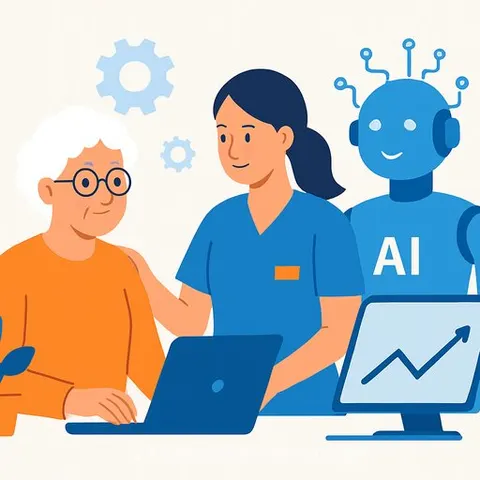
Home care agencies across Connecticut are integrating artificial intelligence into daily operations - from scheduling shifts to detecting early signs of illness - as providers look to close gaps in patient monitoring and ease administrative workloads that consume staff time. The shift, accelerated by pandemic-era demand for virtual care, now touches an estimated 40% of member agencies within the Connecticut Association for Healthcare at Home, according to the group's president and CEO.
"Everything we do is technology first," said Chris Weldon, co-founder of Fairfield-based Endurance Home Care LLC. "We came from an industry where technology was at the forefront of hedge funds for many years, and we said, 'This is something that needs to be brought into this world and really utilized.'"
Weldon and his brother launched the company after their grandmother's Alzheimer's and dementia diagnosis revealed what he described as significant gaps in support for patients, families, and caregivers. The concierge-style agency now deploys AI across billing, payroll, and a client monitoring system called Endurance Technology Solutions.
How AI fills the hours caregivers aren't there
One AI-powered product detects changes in daily routines - more frequent bathroom visits, shifts in coughing patterns - that could signal a developing health issue. "We might be on service three days a week, but then there's lots of hours we're not there," Weldon said. When an alert triggers, all monitoring team members receive the notification and follow established protocols: calling 911, contacting family, or dispatching a caregiver for a check-in.
"And when you combine that data set with a good overseer, who is a nurse and a good caregiver, who's in the home, who's aware of what's going on, that's really closing the loop," Weldon said.
Tracy Wodatch, president and CEO of the Connecticut Association for Healthcare at Home, said the pandemic pushed more agencies toward technology as demand for virtual services surged. Remote patient monitoring systems using two-way cameras and microphones have become more common as the technology improves. But she cautioned against treating all tools as interchangeable. "If you've seen one AI solution, you've seen one AI solution," she said.
Administrative AI reduces hours of phone calls
At Assisted Living Services in Cheshire, a non-medical home care agency operating since 1996, AI now handles shift scheduling - a task co-owner and COO Mario D'Aquila called historically challenging. Before the change, staff spent hours calling caregivers whenever a shift opened. The AI-powered program sends automatic alerts to caregivers, then matches the most appropriate person to the client's needs, preferences, and care requirements. A supervisor still submits final approvals.
"AI might just assign them automatically, just based on attributes. It doesn't really know how they did with other clients and different things like that," D'Aquila said. "So, it does require, at least on our end, some manual intervention."
On the client side, the agency's sister company offers AI-powered safety tools including wearable alert monitors and audio monitoring systems. D'Aquila said the model shifts from keeping a staff member with a client all day to augmenting service with technology, freeing caregivers to support residents who need more hands-on care. Some emergency call centers now use AI to triage initial inquiries, immediately transferring emergencies to a human operator while filtering out false alerts that clog monitoring centers.
Reducing documentation burden to focus on patients
Chris Pankratz, president and CEO of Masters in Home Care LLC, said his agency is evaluating AI tools that deliver "the most practical workflow improvements." Founded in 2012, the company provides skilled nursing and rehabilitation support after hospital stays. Pankratz sees the biggest near-term opportunity in reducing documentation burden.
Caregivers collect large volumes of information through direct care and remote monitoring. AI can analyze that data and surface key insights without requiring staff to sift through extensive notes, potentially identifying concerning changes in a client's condition sooner. Over the next 12 months, the agency plans to upgrade its electronic medical records system to incorporate AI tools. "These aren't necessarily the flashiest tools, but they're the ones that really save time and reduce information," Pankratz said.
He emphasized that client-facing tools analyzing health data are meant to support decision-making, not deliver the final clinical determination. Strategic use matters, he said, to avoid overreliance, alert fatigue, and to maintain transparency with clients. "AI is very good, and I think it gets better every day. … I don't know that it ever will be where it could really replace the importance of the hands-on clinician," Pankratz said. "I think it can just help us do our jobs better."
Why this matters for healthcare professionals
AI adoption in home care is not about replacing clinicians. The Connecticut agencies deploying these tools are targeting specific operational pain points: scheduling chaos, documentation overload, and the blind spots between caregiver visits. For healthcare professionals, the message is practical - AI that reduces administrative friction can return hours to direct patient care, but every tool requires human oversight to match clients appropriately and interpret alerts in clinical context. Wodatch's point stands: each AI solution is a single solution, and its value depends entirely on how well it fits a specific agency's workflow and patient population. As more organizations explore AI for healthcare applications, the emphasis remains on augmentation, not automation.