
AI news ·
Connecticut law requires employers to disclose AI use in hiring decisions and notify workers of AI-driven layoffs
Connecticut now requires employers to disclose AI use in hiring, promotion, and firing decisions under a law signed May 29, 2026. Key notice requirements take effect October 1, 2027; WARN Act AI disclosure rules start October 1, 2026.
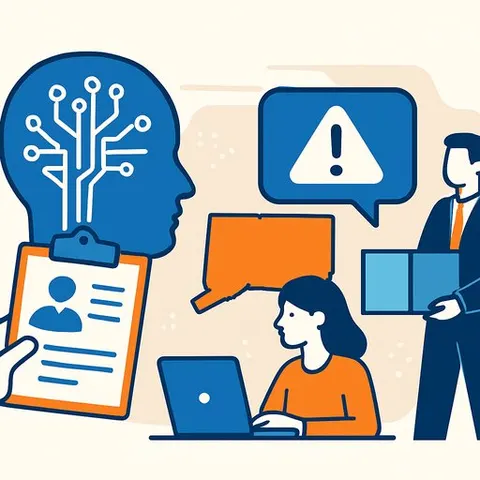
Connecticut Requires Employers to Disclose AI Use in Job Decisions
Connecticut Governor Ned Lamont signed legislation on May 29, 2026, that restricts how employers can use artificial intelligence in hiring, promotion, and firing decisions. The law takes effect in phases, with some requirements starting October 1, 2026, and others on October 1, 2027.
The law applies to any "automated employment-related decision technology" that processes personal data to generate predictions, recommendations, rankings, or scores used to make or influence hiring, promotion, discipline, or termination decisions. It also covers decisions about tenure, job privileges, or conditions of employment.
What Employers Must Disclose
Starting October 1, 2027, employers deploying AI tools in Connecticut must provide written notice to affected employees and applicants before making employment decisions. The notice must include:
- That the employer has deployed the technology
- The technology's purpose and what employment decision it affects
- The trade name of the technology
- Categories of personal data the technology will analyze and how it assesses that data
- Where that personal data comes from
- The employer's contact information
Employers need not disclose use of the technology when it would be obvious to a reasonable person that they are interacting with an automated system. The law also excludes common software tools like word processors, spreadsheets, and anti-virus programs, as well as decisions about scheduling, workplace safety, and productivity monitoring.
Failure to provide the required notice constitutes an unfair or deceptive trade practice, enforceable only by the state attorney general. The law does not create a private right of action for notice violations. However, the attorney general may allow employers sixty days to fix violations occurring before December 31, 2027.
AI Use Cannot Shield Employers From Discrimination Claims
Connecticut's employment discrimination law still applies to decisions made by AI tools. Employers cannot use the fact that an AI system made a decision as a defense against discrimination complaints.
Courts and the Connecticut Commission on Human Rights and Opportunities may consider evidence of anti-bias testing or other proactive efforts to prevent discriminatory outcomes as a mitigating factor. The quality, recency, scope, and results of such testing all matter.
Transparency Required for AI-Related Layoffs
When employers notify the state Labor Department of plant closings or mass reductions in force under the federal WARN Act, they must disclose whether those reductions relate to the use of artificial intelligence or other technological changes. This requirement takes effect October 1, 2026.
Whistleblower Protections for AI Developers
The law establishes protections for employees of large "frontier developers" - companies building foundational AI models with autonomy and the ability to influence physical or virtual environments. These developers cannot discharge, discipline, or retaliate against employees for reporting safety concerns or catastrophic risks to public health and safety.
By January 1, 2027, large frontier developers must establish an internal process allowing employees to anonymously report safety concerns. Developers must investigate reports and provide reasonable updates to employees and their officers and directors at least quarterly. Violations can result in civil penalties up to $1,000 per violation.
What Employers Should Do Now
Legal teams should evaluate which AI tools their company uses in employment decisions and whether those tools fall under the law's definition. Review current notice and disclosure procedures for AI use in hiring, promotion, and termination.
Consider conducting bias audits of AI tools to assess potential disparate impact exposure. If the company lacks an AI governance and use policy, develop one. Finally, assess whether any planned or recent reductions in force relate to AI or other technological changes, and determine what disclosures may be required.
The law reflects a broader shift toward AI regulation at the state level. Other jurisdictions continue to pass their own AI rules, though some have scaled back earlier versions. This creates a patchwork of requirements that employers with multistate operations must navigate.
For additional guidance on AI's role in employment decisions, see our resources on AI for Human Resources and AI for Legal.