Why AI Chatbot Integration Is Reshaping Finance Models
Chat is becoming a transaction layer. The latest moves from PayPal, OpenAI, and Stripe show how quickly conversations are turning into checkouts - and what that means for finance and customer support teams.
From chat to checkout: PayPal + OpenAI
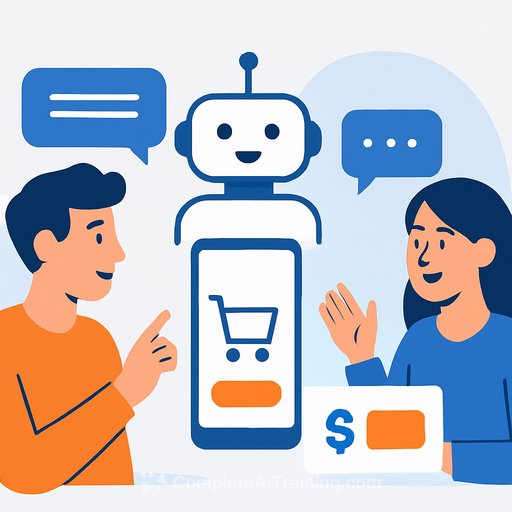
PayPal has partnered with OpenAI to connect its payments stack to ChatGPT through the Agentic Commerce Protocol. In practice, that means people can find a product in a conversation and complete the purchase inside the same chat using their existing PayPal account.
Alex Chriss, PayPal's President and CEO, said the goal is to take millions of people from chat to checkout in a few taps across both user bases. Post-purchase, PayPal will handle the familiar work: order tracking, dispute flows, and issue resolution - all tied into the chat experience.
Internally, PayPal is rolling out ChatGPT Enterprise to more than 24,000 employees and expanding direct use of OpenAI APIs. Engineering teams get code assistance with Codex while operations teams look to automate routine tasks and speed up analysis.
Instant Checkout with Stripe: the protocol in action
OpenAI has launched Instant Checkout for US users, built with Stripe and released as open-source via the Agentic Commerce Protocol. The protocol defines how AI systems pass orders to merchants while keeping control of payments and customer relationships with the business, not the model.
Stripe's leadership framed it as building the economic rails for AI commerce, with agent-led transactions set to become normal. The initial rollout features Etsy items, followed by access to over a million Shopify merchants. Early brands include Glossier, SKIMS, and Vuori.
Product ranking stays organic and unsponsored. ChatGPT returns items based on relevance to the query, not availability of Instant Checkout. As Fidji Simo, OpenAI's CEO of Applications, put it: the aim is to let people complete purchases seamlessly in conversation while letting businesses plug in with their existing payment stack.
After a purchase decision, ChatGPT uses the protocol to send the order to the merchant's backend. The merchant accepts or rejects the order, charges through their usual provider, and fulfills through their existing systems.
What this means for customer support and finance teams
- Chat as a sales channel: Support is no longer just post-purchase. Conversations convert. Track chat-to-checkout conversion, average order value, and CAC/LTV impact by entry point.
- Post-purchase inside the thread: Order lookup, refunds, returns, shipping updates, and disputes all live in the same chat. Shorten time-to-resolution with proactive status pushes and automated triage.
- Risk and fraud shift left: Agents and analysts will see new fraud patterns (promo abuse, account takeovers, social engineering via chat). Add device signals, velocity checks, and step-up authentication at decision points.
- Cost and throughput: Automate repeat intents (balance checks, order status, reorders). Route complex cases to humans with full conversation context. Watch containment rate and escalate when confidence drops.
- Data governance: Minimize and mask PII. Keep PCI in the merchant flow. Log prompts and decisions for audit, with retention aligned to policy.
- Training and change management: Update scripts for conversational commerce. Teach agents to co-work with AI (verify, correct, escalate). Refresh QA scorecards to include accuracy, compliance, and tone in chat-led orders.
90-day implementation playbook
- Weeks 0-2: Plan
Define use cases (discovery, checkout, order support). Set KPIs (conversion, CSAT, dispute rate, handle time). Pick processors and scope data sharing. Run security and compliance reviews. - Weeks 3-6: Prototype
Start with a limited SKU set and sandbox payments. Connect product catalog, inventory, pricing, and order APIs. Add human-in-the-loop for order confirmation. Ground responses in approved content and policies. - Weeks 7-10: Payments and risk
Enable step-ups (e.g., 3DS/SCA) on risk signals. Add consent prompts before charges. Codify chargeback handling. Set rate limits, abuse detection, and a kill switch for the agent. - Weeks 11-13: Support flows
Implement order status, cancellations, refunds, returns, exchanges, and replacements. Build clean handoffs to agents with full chat history and order context. Set quality gates before expanding coverage. - Launch and learn
Roll out to a segment. A/B test prompts and flows. Monitor CX+risk dashboards in real time. Iterate weekly.
Architecture at a glance
- User asks for a product or help in chat.
- Agent retrieves products by relevance and explains options clearly.
- User confirms; agent prepares an order with the protocol.
- Merchant backend verifies price, inventory, and eligibility.
- Payment is handled by the merchant's provider; no raw card data passes through the model.
- Fulfillment is scheduled; confirmations and updates return to the chat.
- All steps are logged for audit and analytics.
Institution adoption: strong signals
Banks and fintechs are deploying chatbots for support, fraud alerts, and guidance. Meta has integrated its assistant across WhatsApp, Messenger, and Instagram, handling tasks like image generation, video restyling, and hands-free communication - all where people already spend time.
Microsoft has embedded GPT-4 into Copilot across Word, Excel, and Teams. Google Cloud leaders emphasized finance as a fast-growing sector, with automation spanning data entry, compliance checks, and report generation - plus assistants that personalize advice using first-party data with appropriate controls.
Platform scale and AI companions
Meta expects generative AI products to bring in US$2-3 billion in 2025. Longer conversations mean richer signals and stronger retention. Leaked reports around Project Omni suggest assistants that can initiate chats, follow up unprompted, and adopt consistent personas tuned to specific audience segments.
Training involves human reviewers simulating long conversations, rating emotional authenticity, and rewriting weak responses. For finance and support leaders, this hints at a near future where AI follows up on abandoned carts, unshipped orders, or billing issues - without feeling robotic.
Risks you must account for
- Incorrect responses and phantom items: Gate product mentions behind real inventory. Require merchant confirmation before charging.
- Ranking and fairness: Keep product ranking decoupled from payment availability. Document rules to satisfy marketing and legal review.
- Privacy and security: Align to PCI-DSS for payments, SOC 2 for controls, and strong data retention limits. Use DLP, secrets management, and isolation for credentials.
- Compliance and disclosures: Clear pricing, taxes, fees, return policy, and consent to transact inside chat. Log rationale for high-risk decisions.
- Abuse and fraud: Watch for coupon cycling, refund abuse, and account takeovers. Add device fingerprinting, IP checks, and behavior analytics.
KPIs that matter
- Chat-to-checkout conversion and average order value
- Refund, return, and dispute rates
- CSAT, first contact resolution, and handle time
- Containment rate with safe escalations
- Agent productivity and cost per resolution
- Compliance incidents and model error rates
Team readiness and upskilling
The tech is here, but performance depends on people and process. Train agents and analysts on prompt patterns, escalation triggers, and verification steps. Refresh SOPs so every action in chat mirrors your risk policy and brand voice.
If you want structured learning paths for finance, support, and operations teams, explore these resources:
AI Productivity Courses
AI Learning Path for Training & Development Managers
Bottom line: chat is becoming where discovery, purchase, and support happen in one thread. The winners will be the teams that ship small, measure tightly, and harden the details - payments, policy, and people - before scaling.
Your membership also unlocks: