Copec's AI customer service playbook: hybrid, multi-agent, and built for speed
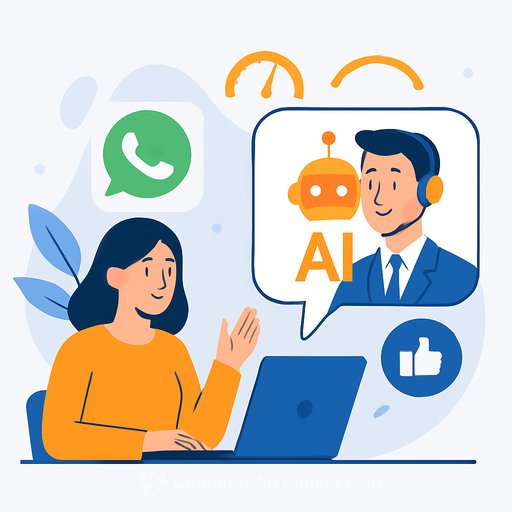
Copec rolled out generative AI to strengthen its service across energy, mobility, and convenience - with a clear mandate: improve the customer experience as processes get more complex. The core move was simple and strategic: make WhatsApp the first layer of service and let AI handle what it should, while humans take the rest.
Early results are hard to ignore: 8x faster resolution times, abandonment cut to a third, and higher satisfaction. AI now handles 79% of monthly interactions - roughly 12,000 conversations - with a system that's been tested for eight months and broadly available for the past month to customers and some subsidiaries.
Why this matters for support leaders
- Channel-first thinking: meet customers where they already are (WhatsApp) and keep the experience consistent.
- Hybrid by design: AI handles the routine; people handle the nuanced. Handoff rules are defined up front.
- Architect for speed: more capability can mean more latency if you're not careful. Design to keep replies snappy.
How Copec built it
The team uses a multi-agent setup on AWS Bedrock with Claude models from Anthropic. There's an orchestrator that routes the request to 5-10 expert agents trained for specific topics like loyalty points, card issues, complaints, and account questions.
Which requests go to AI vs. a human isn't left to chance. "We must be able to identify this very quickly so as not to generate unnecessary noise for the client," said Tomás Irarrázaval, deputy manager of Technology and Business at Copec. The goal: fast triage, clean handoffs, and no looping.
On intent design and routing, Irarrázaval was direct: think through the architecture so processing times don't creep up. You can add more agents as needed, but only if the system stays responsive.
Results so far
- Resolution time: 8x faster.
- Abandonment: down to one-third of prior levels.
- Satisfaction: up.
- Coverage: AI resolves 79% of interactions across roughly 12,000 monthly WhatsApp conversations.
- Rollout: tested for eight months; wide availability since last month for customers and some subsidiaries.
What to copy for your own operation
- Pick one primary channel and perfect it before expanding.
- Define your "AI handles vs. human handles" policy with clear thresholds. Route early if confidence is low.
- Start with an orchestrator plus a few expert agents. Add agents only if latency and accuracy stay within targets.
- Track the three core KPIs weekly: time to resolution, abandonment, and CSAT. Celebrate the wins publicly to drive adoption.
- Write playbooks for handoffs: what context to pass, what to summarize, and how to close the loop with the customer.
What's next for Copec
Expansion to other service channels is on the table. Generative voice for phone service is being tested, but the team isn't convinced it's the right move yet. They'll validate quality before committing.
Near-term focus: use AI to analyze interactions, extract insights, and measure process compliance. That's where operational improvements compound.
Tech stack snapshot
- First layer: WhatsApp-based service with generative AI.
- Core platform: multi-agent system on AWS Bedrock.
- Models: Claude by Anthropic.
- Roles: one orchestrator agent plus 5-10 expert agents.
Quote worth keeping
"We are incorporating technology to generate value for customers, not to generate efficiency." - Tomás Irarrázaval, Copec
Want to level up your team's AI skills?
If you're building similar Claude-based workflows for support, this certification can help your team ramp faster: AI Certification for Claude.
Your membership also unlocks: