
AI news ·
Cornell physicist leads $2.9 million DOE project to train AI to operate particle accelerators
Cornell physicist Georg Hoffstaetter secured a $2.9M DOE grant to train AI on real-time particle accelerator control at Brookhaven Lab. The project uses digital twins of two accelerators to test AI before any live deployment.
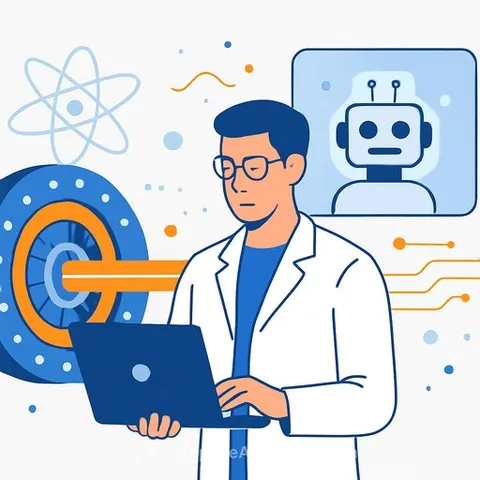
DOE Funds Project to Train AI Systems on Particle Accelerator Operations
A Cornell physics professor has secured a $2.9 million Department of Energy grant to teach artificial intelligence systems how to operate particle accelerators, among the most complex machines in science.
Georg Hoffstaetter de Torquat leads the project, based at Brookhaven National Laboratory on Long Island. The work will train AI on computer simulations of two accelerators: the Relativistic Heavy Ion Collider (RHIC) and the planned Electron-Ion Collider (EIC).
Currently, AI assists scientists after experiments conclude by processing massive datasets. This project moves AI into real-time operational control-making decisions about how experiments run as they happen.
"This research is a step toward a future in which the world's most complicated scientific instruments, like particle accelerators, telescopes, or fusion experiments are routinely operated by AI co-pilots or even AI pilots," Hoffstaetter said.
What This Means for Operations Teams
For operations professionals, this work signals a shift in how complex systems get managed. Rather than humans monitoring and adjusting equipment continuously, AI agents could handle routine operational decisions in real time.
The project uses digital twins-computer models that mirror the physical accelerators-to train AI systems safely before any real-world deployment. This approach lets teams test AI performance under controlled conditions.
Hoffstaetter suggested the work may eventually enable AI to propose and test its own physics hypotheses, moving beyond execution into experimental design itself.
The grant supports a broader trend: AI for operations in fields where human operators manage intricate, data-intensive workflows. Particle accelerators represent an extreme case, but the principles apply across industrial and scientific operations.